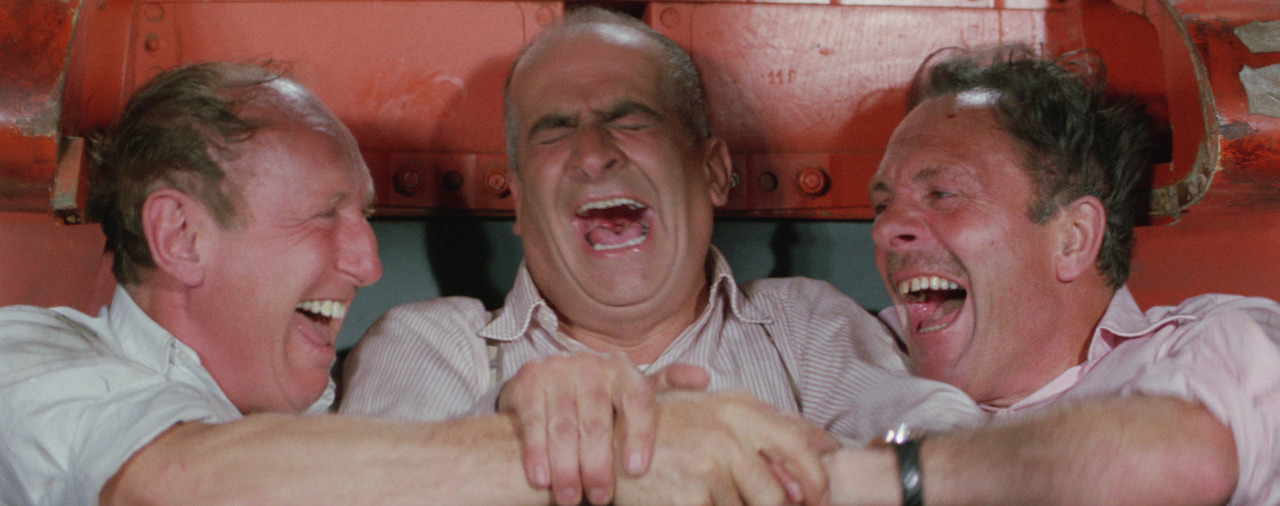
 Image courtesy of France Channel, La Grande Vadrouille(1966)
Gérard Oury's La Grande Vadrouille (1966) occupies a remarkable place in French popular cinema. Set during the German occupation of France, the film follows a collection of very different French civilians who become involved in helping British airmen escape from occupied territory. Starring Louis de Funès and Bourvil, it transforms the potentially sombre subject of wartime occupation into an exuberant comedy of disguises, misunderstandings, accidents and improbable acts of courage.
Yet beneath its slapstick surface, La Grande Vadrouille offers an affectionate reflection on the relationship between France and Britain. The film's British characters are at the centre of its narrative, but it is the French characters who must repeatedly improvise in order to protect them. The result is a comic vision of Franco-British cooperation in which language, nationality and temperament may create confusion, but ultimately do not prevent solidarity.
The film's historical setting is important. During the Second World War, Britain and Free French forces became partners in the struggle against Nazi Germany. Following the fall of France in 1940, Britain provided an important base for General Charles de Gaulle and the Free French movement. British and French personnel subsequently worked together through military, intelligence and resistance networks. This history gives La Grande Vadrouille its fundamental premise: British servicemen find themselves dependent upon French civilians in a country under German occupation.
Oury's great comic invention is to place this international cooperation in the hands of ordinary people. The protagonists are not presented as conventional action heroes. Augustin Bouvet, played by Bourvil, is an apparently unremarkable house painter, while Stanislas Lefort, played by de Funès, is an irritable and self-important conductor. Their involvement in the escape of the British airmen is initially accidental rather than heroic.
This is precisely what makes the film's treatment of Franco-British relations so effective. The alliance is not presented as the exclusive achievement of generals and politicians. Instead, it is translated into relationships between individuals. French civilians encounter British airmen not as abstract representatives of an allied power, but as vulnerable human beings who need help. The international relationship consequently becomes a series of personal encounters. Humour is central to this transformation.
One of the film's most persistent comic devices is the difficulty of communication. The British characters speak English while the French protagonists speak French, creating opportunities for misunderstandings and visual comedy. Yet the linguistic divide is rarely portrayed as an insurmountable problem. The characters find ways to communicate through gestures, expressions, improvisation and sheer determination.
In this respect, the comedy contains a surprisingly optimistic message about cultural difference. The characters do not need to speak the same language perfectly in order to cooperate. Their shared objective creates a form of understanding that exists beyond vocabulary. The joke is often that communication appears impossible — and then somehow succeeds.
The film also plays with national stereotypes, but generally in a spirit of affectionate caricature. British reserve, French temperament, military discipline and civilian improvisation can all become sources of comedy. De Funès's frantic energy contrasts particularly well with the more understated presence associated with the British characters. These differences create comic friction, but they also make cooperation entertaining to watch. The humour therefore depends upon contrast rather than hostility. France and Britain are funny precisely because they are different.
This is significant in a film made only two decades after the end of the Second World War. The war was still within living memory for much of the film's original audience. La Grande Vadrouille could have approached its subject through solemn remembrance alone. Instead, it chooses comedy. The decision allows audiences to revisit a painful period of French history while also emphasising courage, friendship and human resilience.
The film's treatment of the British airmen is particularly revealing. They are not simply heroic foreigners who arrive to save France. They are placed in a position of dependence upon French civilians, reversing the traditional hierarchy between military heroism and civilian vulnerability. The French characters become protectors and collaborators, while the British characters become guests who must trust people they have never met. This reversal creates the foundation for the film's comedy but also reinforces its vision of solidarity. The British need the French, and the French choose to help the British.
The comic adventures that follow repeatedly reinforce this relationship. Characters must hide one another, invent identities, evade German soldiers and improvise increasingly elaborate solutions to problems. The absurdity of these situations makes the protagonists appear almost accidentally heroic. They frequently seem overwhelmed by circumstances, yet their willingness to