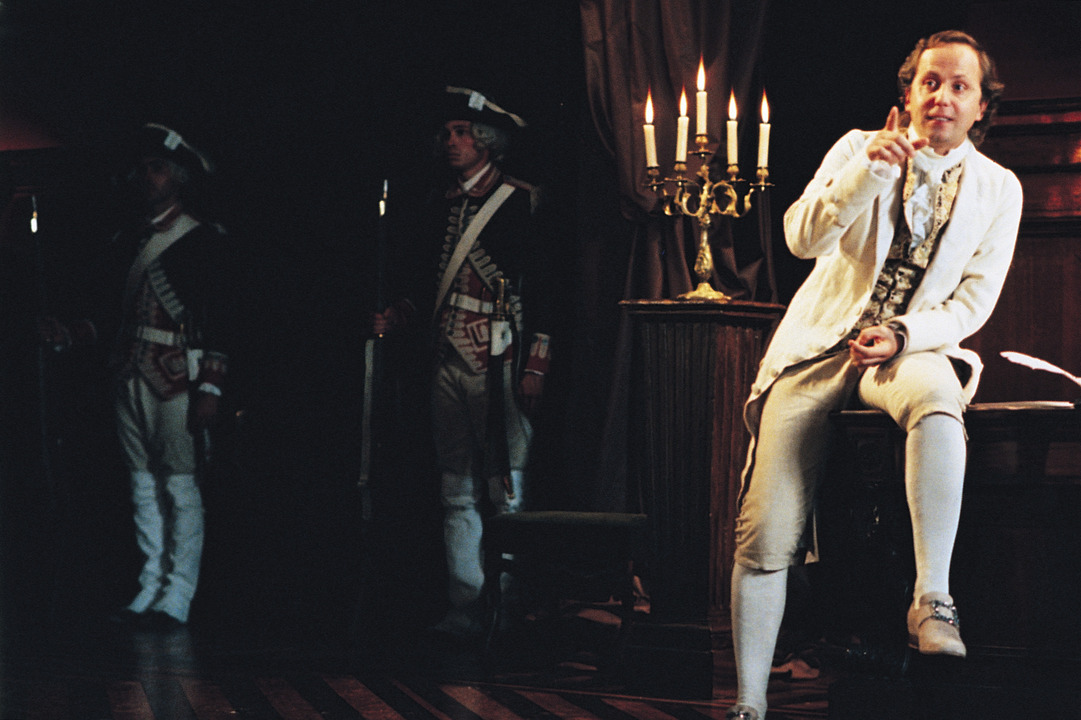
 Image courtesy of France Channel, “Beaumarchais l’insolent” (1996)
Beaumarchais l’insolent approaches its subject less as a historical biography than as a meditation on performance as a political technology. The film constructs Pierre-Augustin Caron de Beaumarchais not simply as an Enlightenment figure, but as a prototype of modern subjectivity: someone who understands that in a world governed by courtly hierarchy, financial opacity, and state intrigue, identity itself becomes a negotiable instrument. What emerges is not a stable portrait of a man, but a study of how theatricality can function as a mode of survival within pre-revolutionary systems of power.
At the center of the film is Pierre Beaumarchais, whose life is presented as a continuous oscillation between roles: playwright, diplomat, financier, pamphleteer, and suspected spy. Rather than treating these identities as separate phases, the film emphasizes their simultaneity. Beaumarchais is not shown as someone who “changes careers,” but as someone who understands that social legitimacy in the late Ancien Régime depends on the strategic multiplication of masks. In this sense, identity is not interior essence but exterior negotiation—an interface between individual ambition and institutional ambiguity.
The film’s argument is that Beaumarchais’ most radical innovation is not theatrical but structural: he internalizes performance as a general principle of action. His famous plays, particularly those that later inform The Marriage of Figaro, are not treated as isolated literary achievements but as extensions of a broader political intelligence. The stage becomes a model of society, and society in turn becomes a kind of unwritten stage, governed by role-playing, timing, and the controlled revelation of information. What the film underscores is that satire in Beaumarchais’ work is not merely critique; it is an exposure of the performative foundations of authority itself.
Within this framework, the Ancien Régime is not depicted as a monolithic structure of oppression, but as a highly theatrical system in which power depends on visibility, etiquette, and the careful management of appearances. Court politics, financial dealings, and diplomatic missions are all shown as variations of the same underlying logic: truth is less important than plausibility, and legitimacy is produced through repetition of form rather than substantive coherence. Beaumarchais thrives in this environment precisely because he understands that sincerity is not the currency of power—credibility is.
The film also foregrounds his role as a political operator in the American Revolution, where he facilitates arms shipments and financial arrangements. This dimension is crucial because it reveals the extension of his performative logic beyond literature into geopolitical practice. In these sequences, Beaumarchais appears less as an idealist and more as an intermediary of systems—someone who translates ideological conflict into logistical execution. Even here, however, the film resists simplifying him into either hero or opportunist. Instead, it emphasizes the structural ambiguity of acting within multiple regimes of legitimacy simultaneously.
A key interpretive thread running through the film is the instability of authorship. Beaumarchais is constantly shown producing texts, reports, and plays that circulate beyond his control, generating consequences that exceed his intentions. Authorship, in this sense, becomes a form of dispersed agency rather than ownership. The film suggests that in the late eighteenth century, writing itself becomes a political act not because it expresses truth, but because it reorganizes the field of visibility in which truth is contested.
Stylistically, the film reinforces this argument through tonal instability. It shifts between comedic energy, historical reconstruction, and moments of near-conspiratorial tension, refusing to settle into a single register. This formal fluctuation mirrors its subject’s own epistemic condition: a world in which meaning is always provisional, and where survival depends on reading situations faster than they can stabilize. The effect is not historical clarity but strategic ambiguity—the sense that every scene could be read as both performance and documentation simultaneously.
Ultimately, Beaumarchais l’insolent frames its subject as an early figure of modern political intelligence, defined by his ability to navigate systems where authority is distributed, contested, and perpetually staged. His “insolence,” as the title suggests, is not merely personal defiance but structural insight: a refusal to treat power as natural rather than constructed. What the film leaves us with is not the image of a singular genius, but the diagram of a world in which genius itself is inseparable from the ability to perform legitimacy convincingly under conditions of constant surveillance, contradiction, and change.