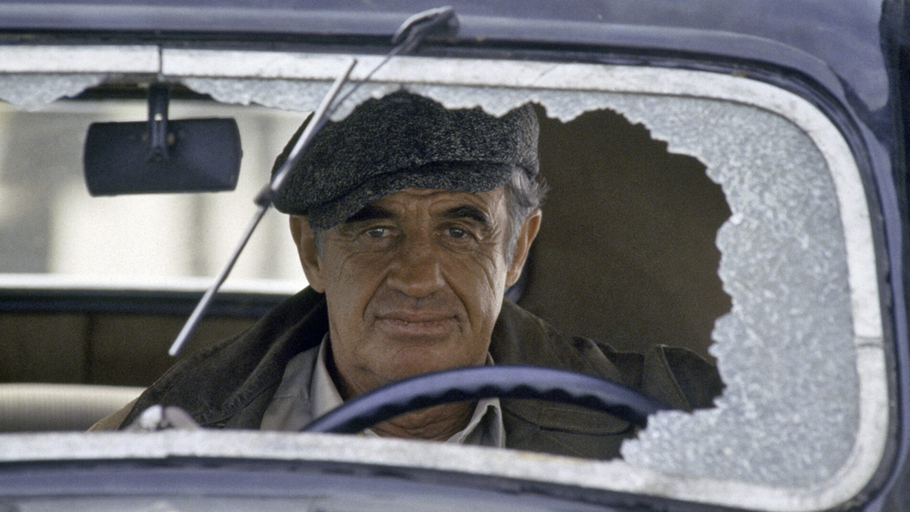
 Image courtesy of France Channel, “Les Misérables,” (1995)
What does it mean to retell a story? For Claude Lelouch, the answer is not necessarily to reproduce its original characters, setting or sequence of events, but to discover how its underlying themes can be made to speak to another historical moment. His 1995 film Les Misérables, starring Jean-Paul Belmondo, is an ambitious demonstration of this principle. Rather than simply adapting Victor Hugo’s nineteenth-century novel, Lelouch transposes its moral universe into twentieth-century France, particularly the period of the German Occupation, creating a narrative in which the experiences of fictional characters echo those of Hugo’s Jean Valjean, Fantine, Cosette, Javert and the Thénardiers.
The result is neither a conventional period adaptation nor a straightforward historical drama. It is a film about the persistence of stories across time, about the repetition of human behaviour under different historical conditions, and about cinema’s ability to transform literary narratives into new forms. Lelouch’s central proposition is that the fundamental stories of humanity are remarkably few, even as the circumstances in which they unfold change. By bringing Hugo’s characters and moral dilemmas into contact with the realities of the twentieth century, he asks whether the injustices, acts of compassion and struggles for dignity depicted in Les Misérables belong to a particular historical period or express something more enduring about human experience.
From nineteenth-century France to the twentieth century
Published in 1862, Victor Hugo’s Les Misérables is a vast social and political novel concerned with poverty, punishment, injustice, redemption and the possibility of moral transformation. Its narrative follows Jean Valjean, an ex-convict whose life changes after an encounter with a compassionate bishop, and examines the social structures that perpetuate suffering. Through Valjean and the people he encounters, Hugo challenges a society that frequently confuses poverty with criminality and punishment with justice.
Lelouch retains these fundamental concerns but relocates them to the first half of the twentieth century. His principal protagonist, Henri Fortin, is not simply a modernised Jean Valjean. He is a character whose life begins to resemble Valjean’s because he encounters situations that reproduce the moral dilemmas of Hugo’s novel. Played by Belmondo, Fortin belongs to a working-class world in which economic hardship, arbitrary injustice and social prejudice determine the possibilities available to ordinary people.
The film initially establishes this connection through Fortin’s family history. His father is unjustly accused of murder and sent to prison, where he dies following an attempted escape. The injustice does not end with his death: his wife and son are left to endure the consequences of a punishment that has destroyed their family. The younger Henri grows up in difficult circumstances, eventually becoming a boxer and then a removal man.
This opening establishes a crucial distinction between adaptation and repetition. Lelouch does not reproduce Hugo’s plot literally. Instead, he identifies a pattern of injustice and transposes it into a different historical and social context. Valjean’s experience of imprisonment and exclusion becomes the starting point for a new story about inherited suffering, social vulnerability and the possibility of resisting the circumstances into which one is born.
The significance of this approach lies in its refusal to treat Hugo’s novel as a historical artefact whose meaning belongs exclusively to nineteenth-century France. By relocating its moral questions to the twentieth century, Lelouch suggests that the social conditions which make Valjean’s story meaningful have not disappeared. Their manifestations have changed, but the underlying conflicts remain recognisable.
The film therefore invites its audience to read Hugo historically and contemporaneously at the same time. Its characters belong to the twentieth century, yet their experiences continually recall a nineteenth-century narrative. The past is not simply reconstructed; it becomes a framework through which the present can be understood.
Henri Fortin: becoming Jean Valjean
The relationship between Henri Fortin and Jean Valjean is the film’s central narrative device. Fortin is introduced as a man with little formal education who nevertheless possesses an instinctive sense of justice. When he encounters the novel through a Jewish family fleeing Nazi persecution, he begins to recognise parallels between Hugo’s characters and his own life.
The Zimans, a Jewish family threatened by the Occupation, introduce Fortin to the story of Les Misérables. Although he cannot read the novel himself, he becomes fascinated by its characters and their struggles. The act of reading aloud consequently becomes more than a means of passing the time. It creates a relationship between literature and lived experience, allowing Fortin to understand his own circumstances through a story written more than eighty years earlier.
Roger Ebert identified this process as one of the film’s most intriguing ideas: Fortin gradually absorbs something of Valjean’s heroism and humanitarianism through his engagement with Hugo’s novel. The literary narrative does not merely reflect Fortin’s life; it helps shape the person he becomes. Roger Ebert’s review of Les Misérables.
This is a particularly revealing departure from the conventional model of literary adaptation. In a straightforward adaptation, the audience watches a fictional character perform the actions described in a novel. In Lelouch’s film, however, the process of adaptation becomes part of the story itself. We watch a character encounter literature and gradually recognise its relevance to his own moral choices.
Fortin does not become Valjean because the two men are identical. Rather, Valjean becomes a model through which Fortin can imagine a different response to suffering. The novel provides him with a moral vocabulary, enabling him to understand that the injustices he witnesses are not isolated misfortunes but part of a larger human pattern.
Literature consequently becomes an instrument of ethical transformation. Fortin’s illiteracy initially appears to separate him from the world of books, but his engagement with Hugo demonstrates that the meaning of literature cannot be reduced to formal education. A story can become significant through listening, identification and the recognition of shared experience.
Lelouch thus proposes that great literature does not simply preserve the past. It remains active because its readers and listeners continually reinterpret it. Fortin’s encounter with Valjean becomes an example of how fiction can influence behaviour in the real world, transforming the way an individual understands responsibility towards others.
The Occupation and the return of Hugo’s moral universe
The Second World War provides the historical setting in which Lelouch’s retelling acquires its greatest political significance. When Fortin encounters the Zimans, their situation exposes him to the persecution of Jewish people under Nazi occupation and to the moral choices faced by those who witness it.
The Zimans’ predicament recalls the vulnerability of Hugo’s marginalised characters. Like Cosette, they are exposed to the cruelty of a society in which power frequently determines who is protected and who is abandoned. Their predicament also places Fortin in a position comparable to Valjean’s: he must decide whether to remain a passive observer or accept responsibility for people whose suffering he could otherwise ignore.
This is where Lelouch’s adaptation becomes more than a historical parallel. The Occupation forces Fortin to put into practice the moral lessons he has encountered through literature. His growing identification with Valjean becomes inseparable from his willingness to help the Zimans escape persecution.
The film thereby establishes a dialogue between two historical contexts. Hugo’s nineteenth-century France and Lelouch’s twentieth-century France are not treated as interchangeable, but their moral problems are placed in conversation with one another. The forms of oppression differ, as do the political circumstances, yet both narratives examine what happens when institutions abandon vulnerable individuals and ordinary people must decide how to respond.
The importance of this connection becomes clearer when considering Hugo’s own political commitments. Les Misérables is not merely a story about individual goodness. It is a critique of social structures that create and reproduce misery. Valjean’s redemption does not erase the injustice of the system that punished him, just as Fortin’s courage cannot undo the persecution taking place around him.
By setting his retelling during the Occupation, Lelouch makes the political dimensions of Hugo’s novel newly visible. The question of justice becomes inseparable from the question of responsibility: what does it mean to behave ethically when the institutions that claim to uphold order are themselves implicated in injustice?
The film’s answer is neither entirely optimistic nor entirely pessimistic. It suggests that individual action matters, but it also demonstrates how difficult moral action becomes when fear, prejudice and political violence structure everyday life.
Recurring characters and the repetition of human behaviour
One of Lelouch’s most distinctive decisions is to distribute the functions of Hugo’s characters across the twentieth-century narrative. Fortin recalls Valjean, while other characters echo the roles of Cosette, Javert, Fantine and the Thénardiers. These are not simply one-to-one equivalents intended to reward viewers who know the novel. They form part of a larger argument about the recurrence of human behaviour.
The idea is articulated explicitly within the film: there are only a small number of fundamental stories, and humanity continually lives them again under different circumstances. The same patterns of cruelty, compassion, exploitation, sacrifice and redemption return in different historical settings.
This principle has important implications for the film’s construction. Rather than presenting history as a linear progression in which each generation leaves the moral problems of the past behind, Lelouch suggests that history is characterised by repetition. The names, places and circumstances change, but recognisable human situations recur.
The Thénardiers, for example, embody opportunism and exploitation. Their significance does not depend on reproducing the exact circumstances of Hugo’s innkeepers. Instead, they represent a recurring willingness to profit from the vulnerability of others. Similarly, the figure of Javert evokes the dangers of an inflexible conception of justice, in which obedience to authority becomes more important than an understanding of human suffering.
These parallels are not intended to erase the differences between individual characters. Rather, they suggest that fiction can create archetypes through which recurring patterns become visible. The same narrative functions can be performed by different people because the conditions that generate them continue to exist.
This is also why Lelouch’s approach has sometimes appeared overly schematic. By insisting on the recurrence of a limited number of stories, the film risks reducing complex historical events to familiar moral roles. Its characters can seem to fulfil predetermined functions rather than develop entirely independently of their literary models.
Yet this schematic quality is inseparable from the film’s central ambition. Lelouch wants viewers to recognise the relationship between the novel and the modern narrative, and the parallels must therefore remain visible. The question is whether those parallels illuminate the historical present or simplify it.
The film’s strongest moments suggest that the repetition of stories can be productive precisely because it does not mean that history is identical. Fortin may resemble Valjean, but he must make his own choices in circumstances that belong to a different century. The inherited story offers a moral framework, not a predetermined destiny.
Cinema reflecting upon cinema
Lelouch’s retelling is also an exploration of cinema’s own relationship with literary history. The film does not confine Hugo’s novel to dialogue and characterisation; it incorporates earlier cinematic representations of Les Misérables into its narrative.
The importance of these references is that they turn adaptation into a visible process. Fortin’s relationship with Hugo’s story is mediated not only by the spoken word but also by cinema itself. The images of earlier film versions provide another layer through which the novel is encountered, remembered and reinterpreted.
Cinema becomes both a medium of transmission and a subject of reflection. The audience watches a film about a man who discovers a novel through a family’s reading, while the film itself draws upon the accumulated history of adaptations that have already given the novel a visual form.
This produces a layered narrative in which the same story exists in several different versions. Hugo’s nineteenth-century novel, earlier screen adaptations, Fortin’s imaginative identification with Valjean and Lelouch’s own twentieth-century retelling coexist within the same cinematic structure.
The result is a film that asks what makes an adaptation faithful. Is fidelity a matter of reproducing the original plot, or can it be achieved by transferring the original work’s moral concerns into a different historical setting?
Lelouch clearly favours the latter approach. His film departs radically from Hugo’s narrative chronology and setting, yet it retains the novel’s concern with social injustice, moral transformation and the possibility of redemption. Its fidelity is thematic rather than literal.
This distinction is important because it reveals that adaptation is itself a creative interpretation. A film cannot simply reproduce a novel without making decisions about perspective, emphasis, characterisation and form. Lelouch makes these decisions unusually explicit by placing the act of retelling at the centre of his narrative.
The film consequently belongs to a tradition of self-conscious cinema that reflects upon its own methods. Its references to earlier adaptations do not merely celebrate the history of Les Misérables on screen; they suggest that every version becomes part of the cultural memory through which subsequent versions are understood.
The moving camera, music and the spectacle of history
Lelouch’s visual style reinforces this concern with the movement of stories through time. His characteristic mobile camera, elaborate transitions and sweeping compositions create a sense of continuous movement, allowing individual lives to become part of a larger historical panorama.
The film’s opening and closing ballroom sequences are particularly revealing. The movement of the camera and the circulation of dancers establish a visual pattern in which people repeatedly meet, separate and return to one another. The dance becomes a metaphor for the narrative itself: individuals move through different relationships and circumstances, yet remain caught within a larger choreography.
Pierre Berthomieu’s analysis of the film for the Groupe Hugo emphasises the importance of this circular movement, connecting the ballroom sequences to Lelouch’s broader conception of narrative and to the visual traditions of filmmakers such as Max Ophuls. Pierre Berthomieu, Les Misérables de Claude Lelouch : « On a tous été Jean Valjean ».
The camera’s movement also suggests that history is not experienced as a sequence of isolated events. Individual lives continually intersect, and apparently minor encounters can alter the direction of an entire narrative. The film’s numerous characters and overlapping storylines become part of a collective history in which no individual experience exists entirely independently of others.
Music performs a related function. Recurring musical passages connect scenes and characters across different periods, producing a sense of continuity that the chronology alone cannot provide. Musical repetition becomes an aural equivalent of the film’s recurring narrative patterns: the same motifs return in different contexts, acquiring new meanings through their association with changing images.
Yet the visual and musical excess also raises a question about Lelouch’s approach to history. His sweeping movements and emotionally emphatic compositions can make suffering appear part of an almost predetermined choreography. The historical narrative becomes a spectacle in which encounters and coincidences converge towards a moral conclusion.
This is both the strength and the limitation of the film’s style. Lelouch’s cinema is generous in its desire to connect people and events, but its insistence on finding meaning in every encounter can make history appear more coherent than it actually is.
The tension is particularly important in a film about the Occupation. Historical suffering cannot always be understood through the reassuring logic of a story in which individual acts of courage restore moral order. Lelouch’s emotionally expansive style encourages faith in human solidarity, but it risks simplifying the historical conditions that make such solidarity necessary.
Universal stories and the politics of memory
Lelouch’s claim that humanity repeatedly lives through a limited number of stories is appealing because it suggests that literature can create connections across historical divisions. A nineteenth-century novel can help a twentieth-century character recognise an injustice, and a contemporary audience can discover its own moral questions reflected in both.
However, the idea of universal stories also requires scrutiny. If every historical event is understood primarily through familiar literary archetypes, there is a danger that specific differences will disappear. The persecution of Jewish people during the Occupation, for example, cannot be reduced to a general story of suffering without losing something essential about its historical and political character.
The film’s challenge is to hold these two perspectives together. It wants to demonstrate the universality of Hugo’s moral concerns while retaining the specificity of the historical circumstances into which it transposes them.
Its most compelling proposition is not that every historical event repeats an earlier story exactly, but that literature can help us recognise patterns of injustice without making those injustices interchangeable. Fortin’s resemblance to Valjean enables him to respond to the Zimans’ predicament, but it does not make their experiences identical to those of Hugo’s characters.
This distinction is essential to understanding the film’s politics. Literature becomes valuable not because it provides ready-made explanations for every event, but because it cultivates the capacity to recognise the humanity of others. The story of Valjean becomes a means through which Fortin learns to see beyond his immediate circumstances.
The film therefore presents storytelling as an ethical act. Stories can preserve memory, make suffering intelligible and encourage people to imagine alternatives to the social structures around them. They can also impose patterns that obscure historical differences. Their value depends on how they are used.
Conclusion: every generation retells Les Misérables
Claude Lelouch’s Les Misérables is best understood as a meditation on the persistence of stories rather than a conventional adaptation of Victor Hugo’s novel. By relocating the narrative’s moral concerns to twentieth-century France, Lelouch demonstrates how literature can remain meaningful beyond the historical circumstances in which it was written.
Henri Fortin’s relationship with Valjean becomes the film’s central example of storytelling as a transformative process. Through his encounter with Hugo’s novel, Fortin discovers a framework through which he can understand injustice and imagine a different response to the suffering of others. Literature does not simply reflect his life; it helps him determine how to live it.
The film’s use of recurring characters, earlier adaptations, mobile camerawork and musical repetition reinforces this idea. Its narrative moves between different versions of the same fundamental story, suggesting that human experience is shaped by patterns that recur across time even as their historical circumstances change.
Yet Lelouch’s film also reveals the risks of this approach. The desire to discover universal patterns can simplify the particularities of history, and the insistence on narrative coherence can make suffering appear more orderly than it is. The film’s ambition lies in the tension between these possibilities: storytelling can illuminate history, but it can never replace history itself.
Ultimately, Lelouch proposes that Les Misérables belongs not only to Victor Hugo or to nineteenth-century France, but to every generation willing to recognise its moral questions anew. Each retelling changes the story by placing it in a different context, while the original continues to shape the meanings that emerge.
The result is a film about the power of literature to travel through time, but also about cinema’s ability to transform inherited narratives into new forms. For Lelouch, the story is never entirely finished. It survives because people continue to discover themselves within it, and because every new historical moment creates another reason to tell it again.