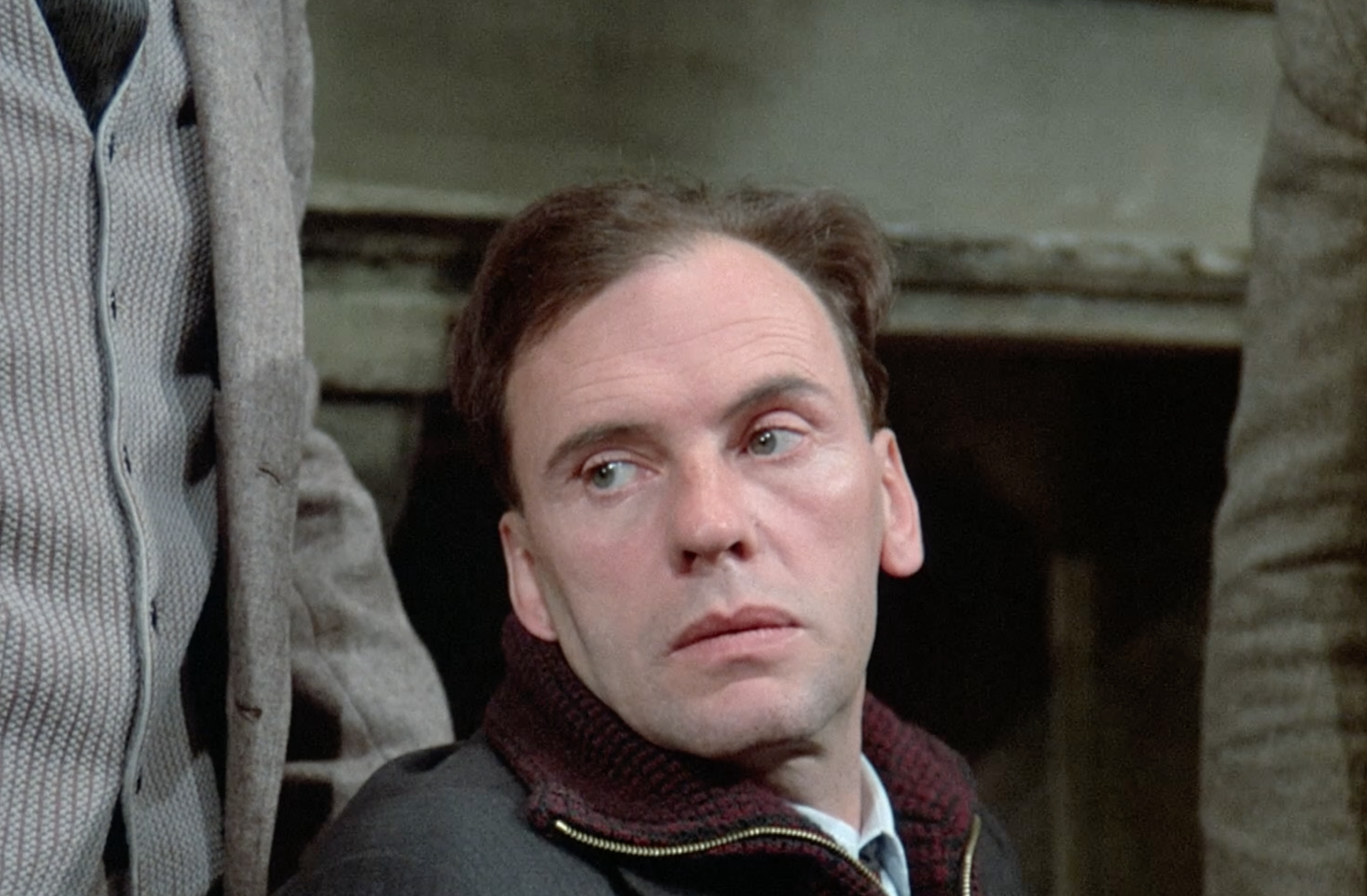
 Image courtesy of France Channel, Flic Story (1975)
Jacques Deray's Flic Story (1975) is ostensibly an Alain Delon film. Delon plays Roger Borniche, the celebrated police inspector whose memoir provides the basis for the story, and the film was constructed around the familiar appeal of Delon as the cool, charismatic French crime-film hero. Yet one of the film's great paradoxes is that its most unforgettable presence belongs to the actor who spends much of the film saying almost nothing. Jean-Louis Trintignant, playing the real-life criminal Émile Buisson, gives a performance of extraordinary restraint. He does not dominate scenes through theatrical outbursts or conventional displays of menace. Instead, he makes stillness frightening. His face remains controlled, his voice rarely rises, and his eyes appear to register everything around him without revealing what he is thinking. The result is a performance in which almost nothing appears to be happening on the surface, while enormous psychological violence seems to exist underneath it. Although Delon is the star of Flic Story, Trintignant repeatedly steals the film from him.
This is particularly striking because the conventional logic of the crime film would seem to favour Delon. He is the protagonist, the investigator and the recognisable star. His presence is immediately legible: Delon's Borniche is elegant, self-assured and physically composed. He occupies the traditional position of the charismatic professional pursuing a dangerous criminal. Trintignant, by contrast, plays the object of the investigation. Buisson is the man being hunted. Yet Deray's decision to give Trintignant such a restrained and enigmatic physical vocabulary means that the criminal gradually becomes more fascinating than the policeman pursuing him.
Contemporary criticism already recognised the unusual power of the performance. Writing in Le Monde in 1975, Jean de Baroncelli argued that Buisson might have been merely a "robot du crime"—a killing machine—if Trintignant had not brought a sense of mystery and hidden fragility to the character. The observation is important because it identifies precisely what distinguishes Trintignant's performance from a generic portrayal of a psychopath. He does not simply make Buisson frightening. He makes him difficult to understand.
That difficulty is created primarily through restraint. Trintignant refuses to give the viewer the emotional information that a more conventional performance might provide. When Buisson is angry, he does not necessarily look angry. When he is about to become violent, there is often no dramatic transformation in his face. When other characters react with fear, Trintignant remains almost unnervingly calm. The effect is to reverse the normal relationship between performance and audience. Rather than showing us what the character feels so that we can respond emotionally, Trintignant withholds information and forces us to watch him more closely.
His eyes become the central instrument of this technique. Buisson's gaze is constantly alert, suspicious and calculating, while his face remains comparatively immobile. This creates the impression of a mind operating at a much faster speed than the body reveals. The audience is consequently placed in the position of Buisson's victims and associates: we have to observe him carefully because we cannot be certain what he will do next.
The restraint is especially effective because the character is capable of extreme violence. The film establishes Buisson as a murderer who can kill with very little apparent emotional disturbance. This creates a disturbing contrast between action and reaction. Violence is not accompanied by the emotional excess that might make it easier to understand. Instead, it appears almost routine. Trintignant's calmness consequently becomes more frightening than rage would have been.
The absence of overt emotion also prevents the audience from safely categorising Buisson as a theatrical villain. He is not constantly snarling, shouting or announcing his intentions. He can sit quietly, converse normally and appear almost ordinary. The threat emerges from the knowledge that this ordinary exterior can coexist with sudden brutality. The character therefore embodies a particularly disturbing conception of violence: not violence as uncontrollable passion, but violence as something that can be carried out calmly and deliberately.
This is one reason Trintignant's performance has retained such power. Later viewers have repeatedly singled out his ability to make Buisson frightening through silence and small movements rather than conventional melodrama. Even contemporary audience criticism has described him as "glacial" and emphasised the extraordinary expressiveness of his eyes despite the relative immobility of his face.
What makes the performance particularly remarkable, however, is that Trintignant does not simply play Buisson as emotionless. There are flashes of something more complicated beneath the surface. The Le Monde review's reference to a "secret fragility" is revealing because it prevents Buisson from becoming a purely mechanical monster. There is something unstable beneath his composure. His stillness does not communicate psychological emptiness; it suggests that the character is constantly containing something.
This containment gives the performance its tension. A less disciplined actor might attempt to communicate madness by exaggerating it. Trintignant does the opposite. He allows the audience to suspect madness without displaying it continuously. Buisson's instability therefore becomes something the viewer has to infer. His eyes move; his attention shifts; his behaviour can become suddenly violent; but his face often remains remarkably composed. The performance asks the audience to imagine what exists behind that surface.
This technique also changes the meaning of silence. Silence in Flic Story is not an absence of performance. It is the performance. Trintignant makes the viewer conscious of every pause because the character appears to be thinking even when he says nothing. A prolonged look becomes equivalent to dialogue. A slight movement of the eyes can alter the atmosphere of an entire scene.
The famous arrest sequence is particularly revealing in this respect. Baroncelli's contemporary review singled out the arrest as an "étonnant morceau de bravoure," emphasising its silences, furtive looks and anxious waiting. This is precisely the kind of scene in which Trintignant's minimalism becomes most effective. The tension does not depend on an explosion of emotion. It depends on anticipation. The audience watches the smallest gestures because the possibility of violence remains constantly present.
The performance is also strengthened by the fact that Trintignant does not attempt to compete with Delon on Delon's own terms. Delon is an actor of extraordinary physical and cinematic presence. He knows how to stand, look and move in a frame so that the camera seems naturally drawn towards him. Trintignant instead makes himself fascinating by refusing to perform conventional charisma. He does not need to appear glamorous. Indeed, part of the fascination of Buisson is the contrast between the actor's own refined screen persona and the character's brutal psychology.
This makes the casting particularly intelligent. Trintignant was famous for playing psychologically complex and often restrained characters, and Flic Story exploits precisely those qualities. The audience does not simply see a violent criminal; it sees Jean-Louis Trintignant's extraordinarily controlled interpretation of one. The distance between actor and character makes the performance even more unsettling. The elegance of Trintignant's presence remains visible beneath the ugliness of Buisson's actions.
The contrast with Delon is therefore essential. The two actors represent two different kinds of screen control. Delon controls the screen through presence. Trintignant controls it through absence.
Delon's Borniche is active. He investigates, interrogates, follows leads and constructs the case against Buisson. His authority comes from action. Trintignant's Buisson is comparatively reactive: he waits, watches and responds. Yet this apparent passivity gives him a peculiar power. Because the audience knows that he is capable of sudden violence, every moment of inactivity becomes suspenseful.
The result is an unusual reversal of the conventional detective narrative. The investigator is supposed to be the person who knows more than the audience and the criminal is supposed to be the mystery that must be solved. In Flic Story, however, Buisson remains psychologically opaque even when the police know where he is. His physical location can be discovered; his inner life cannot.
This is also why Trintignant's performance works so well within Deray's relatively sober style. Flic Story is not constructed as an extravagant gangster spectacle. ARTE describes Deray's film as sober and tense, while noting that its historical setting and realistic approach distinguish it from more sensational crime films. The restraint of the direction gives Trintignant's restraint room to operate. There is no need for him to announce the character's menace because the film itself does not constantly announce its own significance.
The historical setting intensifies this effect. Flic Story is based on Borniche's account of his pursuit of Buisson, which lasted from 1947 to 1950. The film consequently emerges from the violent atmosphere of postwar France, a period still marked by the upheavals of the Occupation and Liberation. Buisson is not an abstract movie villain; he belongs to a society in which violence has recently become normalised. His coldness therefore feels particularly disturbing because it exists within a broader landscape of social instability.
The film also complicates the opposition between policeman and criminal. Borniche and Buisson are obviously on opposite sides of the law, but their relationship gradually becomes more psychologically complicated. Baroncelli described the relationship as developing into a kind of "complicité" between former adversaries, a bond created by the fact that both men have spent years pursuing and evading one another. Their connection resembles that of two specialists who understand each other precisely because they have spent so long studying each other.
This makes Trintignant's restraint even more significant. He does not need to explain Buisson because the relationship with Borniche allows the character to be defined through opposition. Delon's policeman watches Buisson; Buisson watches back. Their performances become a dialogue of gazes.
Indeed, the film's central conflict might almost be described as a battle over who can remain composed for longer. Borniche is professional, methodical and controlled. Buisson is violent but similarly self-possessed. The difference is that Borniche's restraint exists within an institutional framework, whereas Buisson's restraint exists outside it. The policeman must obey rules, procedures and professional constraints; the criminal has fewer such limitations. This gives Buisson's calmness a dangerous freedom.
Delon's performance is therefore crucial precisely because it provides the counterweight to Trintignant. It would be too easy to say that Delon is simply outperformed. His understated Borniche is necessary to the film's balance. Contemporary criticism praised Delon's ability to convey the inspector's character through quick scenes and sparse dialogue, while ARTE has described the two performances as successfully giving each actor the opportunity to hold his own against the other.
Yet Trintignant's advantage is that mystery is inherently more captivating than certainty. We understand Borniche. We know what he wants and why he is pursuing Buisson. Buisson remains unknowable. Every appearance therefore carries a small question: what is happening behind that expression?
This is why Trintignant can steal a scene without apparently doing anything. He does not have to raise his voice or make a dramatic entrance. The camera can simply remain on his face and the audience begins searching for information. His minimalism creates attention. The less he gives, the more the viewer looks.
There is a particularly modern quality to this performance. Contemporary crime cinema frequently associates menace with understatement: the most frightening character in a scene may be the one who speaks quietly, waits patiently and never appears to lose control. Trintignant's Buisson anticipates this form of screen villainy. His violence is frightening precisely because it is not accompanied by theatrical villainy.
But the performance is ultimately more sophisticated than the idea of the "cold-blooded killer" suggests. Trintignant does not reduce Buisson to coldness. His eyes remain restless even when his face is still. His apparent calm is therefore not serenity. It is concentration. The distinction is crucial. A serene character appears to have nothing to fear; Buisson appears constantly to be calculating what might happen next.
This produces an almost animalistic quality. He watches. He waits. He assesses. He reacts. Yet the comparison should not be understood as implying mindlessness. Quite the opposite: Trintignant makes Buisson frightening because the character appears intensely conscious of his surroundings.
The performance is thus an extraordinary demonstration of how much an actor can communicate by doing less. Trintignant understands that the camera magnifies the smallest gesture. A glance can become an event. A pause can become suspense. A neutral expression can become a threat. And this is ultimately why Jean-Louis Trintignant steals Flic Story. The film may belong nominally to Alain Delon, and Delon's star power is fundamental to its identity. But Trintignant understands something about the camera that is more difficult to achieve: he makes the audience watch him even when he is not asking to be watched.
Delon gives the film its surface glamour and professional cool. Trintignant gives it its psychological unease. Delon's Borniche is the man pursuing the story; Trintignant's Buisson is the mystery at its centre. The policeman explains the narrative, but the criminal gives it its atmosphere. In the end, the most impressive aspect of Trintignant's performance is not that he plays a terrifying man. It is that he almost never appears to be trying to terrify us. There is no obvious effort to dominate the scene. Instead, he withdraws, observes and waits. The restraint becomes the menace. The silence becomes the dialogue. The stillness becomes movement.
Flic Story may have been designed as an Alain Delon vehicle, but Jean-Louis Trintignant turns it into something more intriguing: a study in the terrifying power of understatement. His Émile Buisson does not need to announce himself as dangerous because the performance makes danger feel like something permanently present beneath the surface. In a film built around a pursuit, Trintignant's greatest achievement is to make the man being pursued feel like the person who controls the screen.