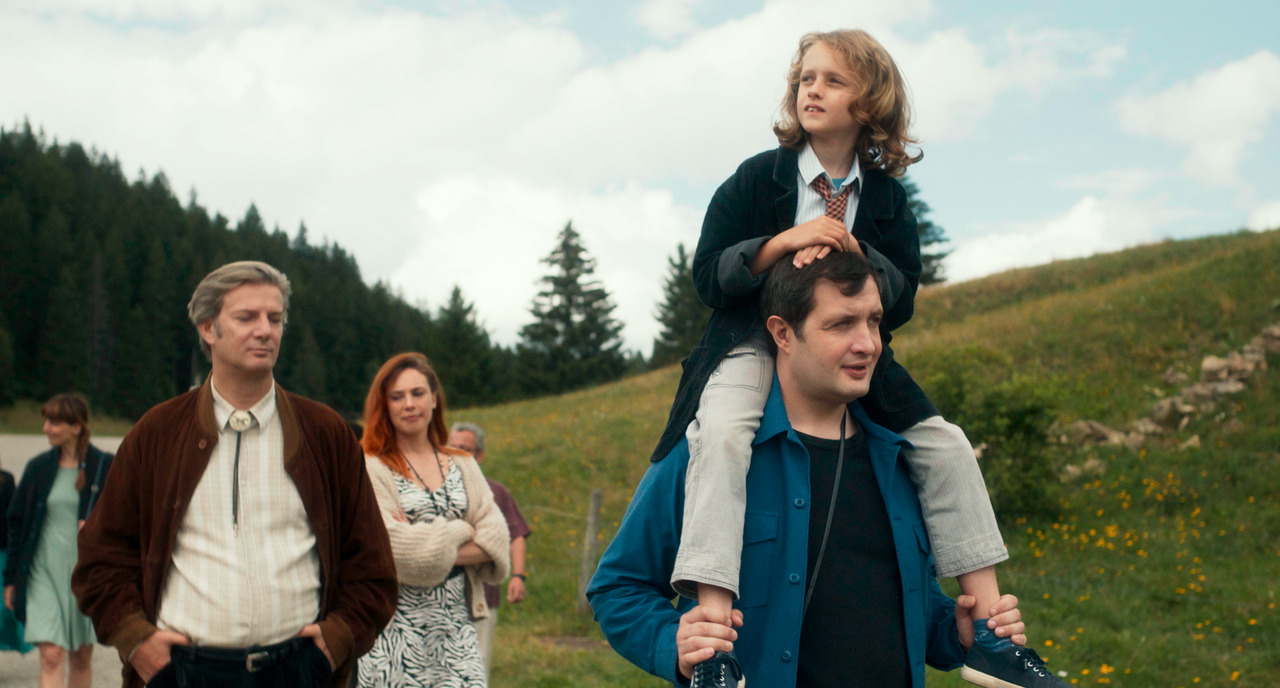
 Image courtesy of France Channel, “Jim’s Story” (2024)
A Family Story That Refuses to Follow the Rules
At first glance, Jim’s Story (Le Roman de Jim, 2024) might seem to belong to familiar territory: a family drama about love, parenthood and the complications that arise when an absent biological father reappears. But the film, directed by brothers Arnaud and Jean-Marie Larrieu, is considerably more unusual than that description suggests. Adapted from the novel by Pierric Bailly, it is a film that begins as an intimate portrait of an unconventional family before gradually becoming a meditation on time, attachment, loss and the often arbitrary nature of the relationships that shape our lives.
The story follows Aymeric (Karim Leklou), who reconnects with Florence (Laetitia Dosch), a former colleague who is six months pregnant and raising her child alone. When Jim is born, Aymeric becomes a devoted presence in his life. The two develop the kind of relationship usually associated with a biological parent and child, and Aymeric builds a family with Florence and Jim in the French Jura. Their peaceful domestic existence is eventually disrupted by the return of Christophe (Bertrand Belin), Jim’s biological father, whose renewed interest in his son destabilises the family unit. This could easily have become a conventional melodrama, complete with a clear antagonist and an inevitable struggle over parental rights. Instead, the Larrieu brothers make something much more ambiguous. Jim’s Story is interested less in who has the right to be a father than in what fatherhood actually consists of.
The Difference Between Being a Father and Becoming One
The film’s central question is deceptively simple: is fatherhood a matter of biology, responsibility, affection, or the accumulation of ordinary shared experiences? Aymeric is not Jim’s biological father, but he is the person who raises him. He is there for the everyday rituals of childhood, the quiet domestic moments and the gradual development of a relationship that becomes fundamental to both of them. His fatherhood is not established through a dramatic declaration. It emerges through repetition: showing up, caring, listening and remaining present.
This makes the eventual disruption of their relationship particularly painful. When Christophe returns, the distinction between biological and emotional parenthood becomes increasingly difficult to navigate. The film does not simply suggest that biology is irrelevant; rather, it exposes how little biological connection can tell us about the emotional reality of a family. One of the film’s most striking qualities is its refusal to turn this conflict into a straightforward moral contest. Christophe is not simply a villain, and Florence's decisions cannot be reduced to cruelty. Each character has their own understanding of what is best for Jim, even when those understandings come into conflict. The result is a story in which emotional damage emerges not necessarily from malice, but from the collision of competing forms of attachment.
An Unusual Portrait of Masculinity
Much of the film’s emotional force comes from Karim Leklou’s performance as Aymeric. He is an unusual protagonist by the standards of contemporary cinema: gentle, accommodating, sometimes passive, and seemingly uninterested in asserting himself through conventional displays of masculine authority.
There is something quietly radical about this characterisation. Aymeric is not a father who establishes his identity through discipline, dominance or control. His relationship with Jim is founded on tenderness and reliability. He is allowed to be vulnerable, uncertain and emotionally dependent without the film treating these qualities as weaknesses. The Larrieu brothers have spoken about their interest in portraying male characters through kindness, fragility and reliability — qualities they feel are less frequently represented on screen. Aymeric embodies this alternative masculinity. His generosity is not presented as a heroic performance, but as an ordinary way of being in the world.
Yet the film is also attentive to the limitations of this gentleness. Aymeric's reluctance to assert himself leaves him vulnerable when the circumstances of his family change. His kindness does not protect him from loss, and his willingness to accommodate others sometimes comes at the expense of his own needs. This tension gives the character a complexity that goes beyond the familiar cinematic ideal of the self-sacrificing father.
The Strange Passage of Time
Perhaps the most unusual aspect of Jim’s Story is its treatment of time. Rather than concentrating on a single dramatic period, the film follows Aymeric and Jim across many years, allowing their relationship to evolve through a series of temporal leaps and narrative ellipses. The effect is almost novelistic. Childhood, adulthood, separation and reunion are not presented as isolated chapters in a neatly structured family saga. Instead, the film moves through time with a certain looseness, reflecting the way relationships continue to exist in memory even when people are no longer physically present in one another's lives.
This structure also changes the viewer's understanding of what constitutes a dramatic event. Some of the most consequential developments occur between scenes, outside the immediate frame. Years pass; people change; circumstances shift. The emotional significance of a relationship becomes apparent not only through what we witness, but through what has disappeared. The film's use of photographs and carefully placed visual transitions reinforces this sense of time passing. Rather than treating the years as a sequence of spectacular turning points, the Larrieu brothers find meaning in the accumulation of ordinary moments. It is a form of storytelling that feels particularly suited to a film about parenthood, which is itself built from countless small acts that rarely seem extraordinary at the time.
The Jura: A Landscape Outside the Parisian Imagination
The film's setting is equally important. Much of Jim’s Story takes place in the Jura region of eastern France, far from the familiar urban settings that dominate international perceptions of French cinema. The landscape provides a sense of geographical and emotional continuity. Rural life is not romanticised as an uncomplicated escape from modernity, nor is it presented as a caricature of provincial France. Instead, the region becomes the setting in which the characters build their relationships, work, raise children and attempt to make sense of changing circumstances.
The film's attention to everyday life gives it a particular intimacy. Its world is made up of homes, workplaces, roads and familiar local spaces rather than the heightened environments of conventional melodrama. This grounded quality makes the story's emotional developments feel all the more unsettling: the events that transform a family can take place within an apparently ordinary life. The Jura is not simply a picturesque backdrop. It is part of the film's understanding of belonging, suggesting that family is shaped not only by blood and legal relationships, but also by shared places and the routines that accumulate around them.
A Melodrama Without a Villain
The term melodrama might initially seem surprising for a film as restrained as Jim’s Story. There are certainly moments of intense emotional suffering, but the Larrieu brothers avoid the exaggerated confrontations and moral certainty often associated with the genre. Instead, they use melodrama to explore the emotional consequences of circumstances that cannot easily be resolved. The film is particularly attentive to the way ordinary decisions can produce extraordinary pain. No single event necessarily explains the family's disintegration; rather, a succession of choices, misunderstandings and changing circumstances gradually alters the relationships between its members.
This refusal to assign blame is one of the film's most affecting qualities. It asks viewers to remain sympathetic to people whose actions may hurt one another, without pretending that good intentions prevent harm. The result is a form of emotional realism that is considerably more complicated than a conventional story about a family torn apart.
Why Jim’s Story Is Such an Unusual French Film
Arnaud and Jean-Marie Larrieu have long demonstrated an interest in moving between genres, from comedy to thriller to musical. With Jim’s Story, they turn to melodrama, but approach it with an understated sensibility that makes the film difficult to classify.
It is at once a family saga, a coming-of-age story, a portrait of rural France and an exploration of the instability of human relationships. Its central character is not a conventional hero, its conflict has no easy resolution, and its narrative is structured around the unpredictable passage of time rather than a straightforward dramatic progression.
At its heart, however, the film makes a remarkably generous argument. Family is not necessarily something that can be defined by a birth certificate, a legal arrangement or a shared surname. It is something people make through their presence in one another's lives — and something that can remain meaningful even when circumstances make that presence impossible.
That is what makes Jim’s Story so moving. It takes a familiar question about who counts as a parent and turns it into something much broader: a reflection on the relationships that make us who we are, the people we lose, and the ways in which love can outlast the structures that once gave it a home.