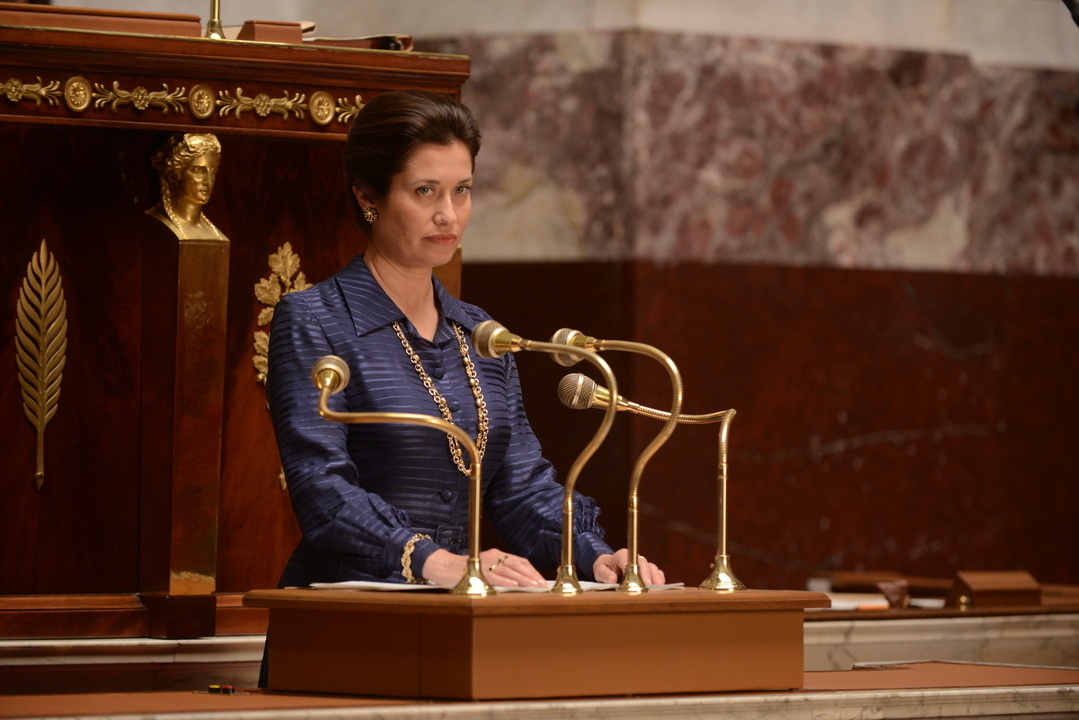
 Image courtesy of France Channel, “La Loi” (2014)
A Turning Point in French History
There are moments in political history when a single parliamentary debate becomes a turning point in the life of an entire country. For France, the passage of the 1975 law legalising abortion was one such moment. At its centre was Simone Veil, then Minister of Health, who faced an overwhelmingly hostile political environment to defend legislation that would fundamentally change women's access to reproductive healthcare. Christian Faure's La Loi (2014), starring Emmanuelle Devos as Veil, revisits the extraordinary parliamentary struggle that preceded the law's adoption. Rather than attempting to tell the story of Veil's entire life, the film concentrates on the tense days of political negotiation and parliamentary debate in November 1974. It is a deliberately focused approach, capturing the personal and political pressures surrounding a woman tasked with defending a deeply controversial reform.
The result is not simply a historical drama about the passage of a law. It is a portrait of political conviction, institutional resistance and the difficult process through which social progress becomes legislation.
Emmanuelle Devos as Simone Veil
The film's greatest challenge lies in its central performance. Simone Veil was an exceptionally recognisable public figure, remembered for her composure, intelligence and distinctive manner of speaking. Portraying her requires more than a physical resemblance: it demands an understanding of the restraint and determination that characterised her public life. Emmanuelle Devos approaches the role without relying on exaggerated gestures or grand emotional declarations. Her performance is measured, attentive to Veil's particular speech patterns and reserved public demeanour. Rather than presenting her as an untouchable political heroine, Devos gives the character a human presence, showing the exhaustion, isolation and emotional strain beneath her composure.
This is particularly important because the film's central tension depends on the contrast between Veil's public authority and the hostility she encounters. She is a government minister, but her position does not protect her from the sexism, antisemitism and personal attacks directed against her. Her authority must be continually asserted in a political environment in which many of her opponents regard her presence as a provocation in itself. Devos's performance captures the extraordinary discipline required to remain composed under such pressure. Her Veil is not without emotion; rather, she understands that losing control in public could undermine the political objective for which she is fighting.
The 1974 Parliamentary Battle
The legislation at the heart of the film emerged from a particularly difficult political and social context. Before the Loi Veil, abortion was illegal in France under the 1920 legislation prohibiting contraception and abortion. Women seeking to terminate pregnancies were frequently forced into clandestine procedures, exposing them to serious medical risks and often devastating consequences. The scale of the problem made abortion an urgent public-health issue, but the proposal to change the law provoked fierce opposition. Religious convictions, conservative social attitudes and competing ideas about the beginning of human life all shaped the parliamentary debate.
When Veil presented her legislation to the National Assembly in November 1974, she was not simply defending a technical amendment to existing law. She was confronting deeply entrenched assumptions about women's roles, sexuality, motherhood and the authority of the state over individual bodies. The parliamentary debates were marked by extraordinary hostility. Veil faced accusations and insults, including antisemitic attacks that drew upon her experience as a Holocaust survivor. The violence of some of the rhetoric was particularly disturbing given that she was speaking as a minister in the French government. The film makes this confrontation central to its narrative. Its political drama emerges not from elaborate action sequences, but from speeches, negotiations, confrontations and the increasingly tense atmosphere of the Assembly.
A Woman Against the Political Establishment
One of the most interesting aspects of La Loi is its portrayal of the political compromises required to achieve reform. Although Veil was a government minister, she could not simply rely on the support of her colleagues. Her legislation divided political parties and exposed tensions within the governing majority itself. Securing enough votes required strategic negotiation, careful rhetoric and an awareness of the political calculations shaping the debate.
The film also introduces the tensions between Veil and other prominent women in government, including Françoise Giroud, then Secretary of State for the Status of Women. Their different approaches to women's emancipation reveal that even among those committed to improving women's lives, there was no single agreed strategy. Where some advocates framed abortion primarily as a question of women's autonomy, Veil also emphasised the suffering and medical dangers experienced by women forced to undergo clandestine procedures. Her approach was pragmatic: she needed to persuade parliamentarians who might not share her broader feminist convictions, but who could recognise the human consequences of the existing law.
This distinction is essential to understanding the political achievement of the Loi Veil. The legislation did not emerge from a moment of universal agreement. It was the result of a difficult process of persuasion, compromise and political courage.
The Personal Cost of Political Courage
Although La Loi is structured around parliamentary proceedings, it also recognises that political conflict rarely remains confined to the institutions in which it takes place. The attacks directed at Veil extended beyond the Assembly, affecting her family and private life. Her position as a Jewish woman and Holocaust survivor made the antisemitic nature of the opposition particularly cruel. The film does not treat these attacks as incidental background noise; they form part of the emotional reality of her political struggle.
This is where the performance of Devos becomes particularly effective. Her portrayal of Veil's composure is not an indication that she is unaffected by what happens around her. Instead, it suggests the effort involved in continuing to perform one's responsibilities while being subjected to sustained hostility. The film also avoids turning Veil into a conventional heroic figure who triumphs through sheer force of personality. Her achievement is inseparable from the political circumstances around her, the support she receives and the strategic decisions she makes. Her determination matters, but so does her understanding of the parliamentary system she must navigate.
A Film About More Than Abortion
Although the Loi Veil is the central subject, La Loi raises questions that extend well beyond the specific legislation of 1975. At its heart is the question of who has the authority to make decisions about women's bodies. The parliamentary debate exposes the extent to which women's reproductive lives had been governed by legal, religious and social structures in which women themselves often had little control.
The film also explores the relationship between public health and morality. By presenting abortion as an issue involving medical danger, social inequality and individual circumstances, it challenges the idea that the prohibition of a procedure necessarily prevents it from taking place. Instead, the existing law had pushed women towards clandestine practices, with the risks falling most heavily on those least able to access safe alternatives. This remains one of the film's most important historical insights. The legalisation of abortion was not simply a symbolic victory for feminism. It was a public-health intervention that recognised the consequences of forcing women to seek medical procedures outside the law.
The film's emphasis on these questions also gives it a contemporary resonance. Although the political and legal circumstances surrounding abortion have changed considerably since the 1970s, debates about reproductive autonomy, medical access and the relationship between individual rights and political authority remain central to public life.
The Importance of the Loi Veil
On 29 November 1974, the National Assembly adopted the legislation by 284 votes to 189. The law was subsequently adopted by the Senate and promulgated on 17 January 1975. The original legislation authorised the voluntary interruption of pregnancy under specified conditions, initially as a temporary framework. Its passage represented a major transformation in French law and in the country's approach to women's reproductive healthcare.
The significance of the law was also deeply personal. For generations of women, clandestine abortion had been a source of danger, secrecy and social stigma. The legislation recognised that criminalisation had not eliminated abortion, but had made it more dangerous. Veil's achievement was therefore both practical and symbolic. She had succeeded in bringing a subject that had long been surrounded by silence into the centre of national political debate. Her intervention helped establish reproductive rights as a matter of public responsibility rather than simply private morality. The legislation would be strengthened and developed in subsequent years, but the 1974 parliamentary battle remains a defining moment in the history of French feminism.
Why La Loi Remains an Important Film
Historical dramas about political reform can sometimes struggle to balance the significance of their subject with the demands of storytelling. La Loi finds its drama in the very mechanisms through which political change takes place: negotiation, rhetoric, opposition and the slow accumulation of support. Its focus on a relatively brief period gives the film a particular intensity. Rather than presenting the legalisation of abortion as an inevitable development, it reminds viewers how uncertain the outcome was and how much depended on the determination of those involved.
The film also benefits from its decision to centre on Emmanuelle Devos's interpretation of Simone Veil. Her performance gives the story an emotional anchor without diminishing its political complexity. Ultimately, La Loi is a film about what it takes to change the law when the law itself reflects the inequalities of the society it governs. It tells the story of a woman who entered one of France's most hostile political debates and refused to abandon the principle that women's lives and health deserved legal protection. More than a historical account of a parliamentary victory, it is a reminder that rights which later generations may take for granted were often secured through extraordinary acts of persistence and courage.