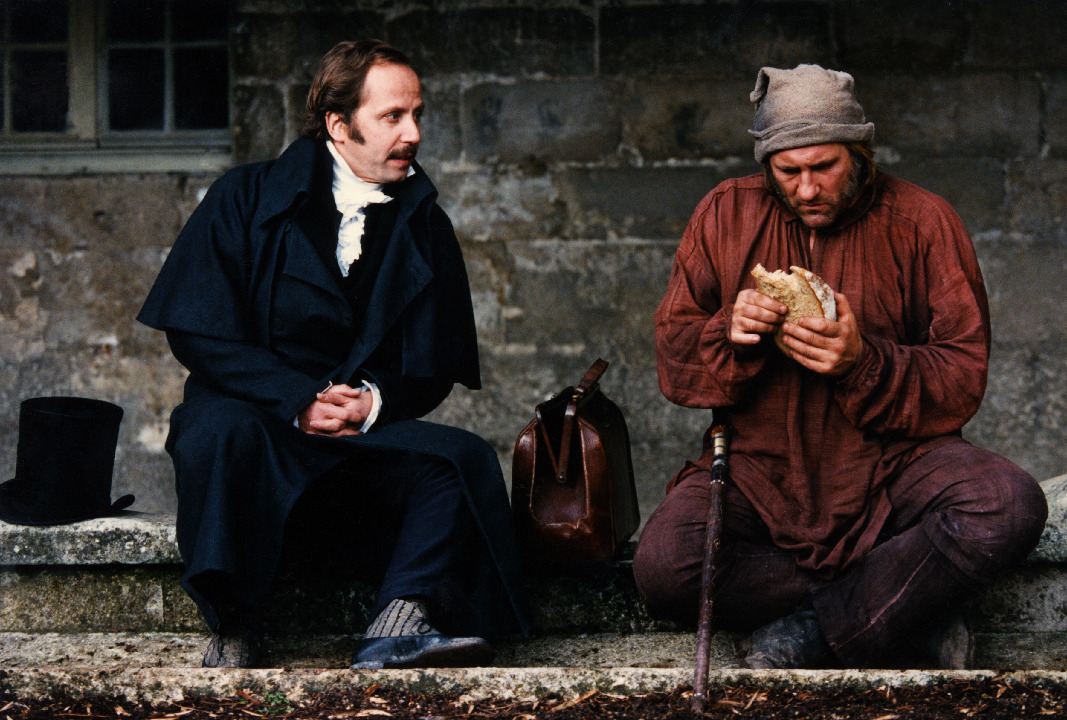
 Image courtesy of France Channel
Yves Angelo’s Le Colonel Chabert is, on the surface, a historical drama about a soldier who returns from the dead. Adapted from Honoré de Balzac’s novella and released in 1994, the film brings together Gérard Depardieu as Chabert, Fanny Ardant as his former wife, and Fabrice Luchini as the lawyer Derville. But the film’s real subject is less resurrection than recognition. Chabert has survived the battlefield, yet survival turns out to be insufficient: in a society organized around documents, property, marriage, and legal identity, a person can be physically alive and nevertheless socially nonexistent.
This is the paradox that gives the film its unsettling force. Chabert has returned from the Napoleonic Wars after being officially declared dead following the Battle of Eylau. Ten years later, he arrives in Paris to discover that his wife has remarried, his fortune has been absorbed into another social order, and his former identity has effectively been redistributed among the living. His problem is therefore not simply that people refuse to believe him. It is that the institutions of society have already made practical arrangements around his absence. His disappearance has become useful.
The film consequently turns a supernatural premise into a distinctly modern bureaucratic nightmare. Chabert's body says one thing; the paperwork says another. His memory says he is Colonel Chabert; the legal system requires evidence. His face carries the history of his own life, but that history has no institutional authority unless it can be authenticated. The fundamental question is therefore not "Is Chabert alive?" but "Who has the power to decide whether he exists?"
This is where Fabrice Luchini's Derville becomes crucial. Luchini is not playing the conventional heroic lawyer who simply takes up the cause of the innocent. Derville occupies a much more ambiguous position. He is an intermediary between lived experience and institutional recognition, someone whose profession consists precisely in translating human claims into forms that the legal system can process. His importance is therefore conceptual as much as narrative. Chabert possesses a story; Derville understands the machinery required to make that story legible.
The contrast between the two men is particularly revealing. Chabert represents memory in its most physical form. He remembers the battlefield, the cavalry charge, the bodies, the pit in which he was buried, and the extraordinary struggle through which he survived. His testimony is excessive because it is experiential. He knows what happened because he lived it. Derville, by contrast, represents a world in which experience must be converted into evidence before it can acquire public validity. The lawyer's task is not to determine whether Chabert's story is emotionally convincing, but whether it can survive contact with institutions.
This makes the film's treatment of the Restoration particularly important. Chabert belongs to the heroic world of Napoleon's Empire, where identity is constructed through military achievement, honour, title, and personal reputation. But he returns to a France that has changed political vocabulary. The Empire has fallen, the Bourbon Restoration has altered the hierarchy of power, and the social order is being reorganized around property, inheritance, marriage, and political legitimacy. Chabert has returned, but he has returned into the wrong historical moment.
His tragedy is consequently temporal as much as personal. He is not simply a man displaced from his home; he is a historical subject who has outlived the system that gave his identity meaning. The title "colonel" carries enormous significance to him because it represents an entire moral universe built around military honour. To the people around him, however, the title has become an inconvenient remnant of a defeated political order. His identity is valuable only insofar as it can be incorporated into the present.
This is also what makes Fanny Ardant's Countess Ferraud more complicated than a conventional villain. Her refusal to simply restore Chabert to his former position can be understood as cruelty, but the film makes it possible to see the structural logic behind her actions. She has built a new life during the decade of his absence. She has remarried and acquired a new social position; her present identity depends upon Chabert remaining dead. The moral conflict is therefore inseparable from a material one. To acknowledge Chabert is not merely to acknowledge a person. It is to dismantle an entire arrangement of property, marriage, inheritance, and status.
This is one of Balzac's most modern insights, and Angelo's adaptation preserves it effectively: relationships are never purely emotional because they exist within economic structures. Love, marriage, reputation, and property are intertwined. The Countess's dilemma is horrifying precisely because it is rational. She has reorganized her life around the assumption that her husband is dead. Chabert's return does not simply restore an old truth; it threatens to destroy the new reality that has been built upon that truth being false.
The film's atmosphere reinforces this idea of social entrapment. Rather than presenting nineteenth-century Paris as a romantic historical landscape, it often feels enclosed, formal, and oppressive. Interiors become spaces of negotiation, while offices and legal rooms seem almost more consequential than battlefields. This reversal is essential. The battlefield is where Chabert nearly dies, but the law is where his identity is finally destroyed. Physical violence creates the wound; bureaucracy determines whether the wounded person still counts.
In that sense, the film is not really nostalgic for the Napoleonic world. If anything, it is suspicious of the heroic mythology represented by Chabert. His courage and sacrifice have little practical value once he returns. The society he fought for does not possess a mechanism capable of adequately receiving him back. Heroism belongs to the past because the present operates according to different currencies.
The most disturbing implication is that Chabert's death may actually have been socially more convenient than his survival. As a dead man, he could be remembered, commemorated, and converted into a story. As a living man, he becomes a problem. He demands property, recognition, legal status, and emotional obligations. The dead can be mythologised; the living make claims.
This distinction gives the film its broader political significance. Modern institutions are often imagined as mechanisms designed to protect individual identity. Le Colonel Chabert suggests the opposite possibility: institutions may also manufacture identity by deciding which versions of a person are administratively real. Chabert's tragedy is therefore not that he has lost his identity, but that his identity has been reassigned.
And this is ultimately where Derville's role becomes so important. Luchini's character stands between two worlds: the human world of memory and suffering and the institutional world of contracts, evidence, and calculation. He understands that justice cannot simply be a matter of believing Chabert. Belief has to be converted into a form the system recognizes. The lawyer therefore embodies both the possibility and the limitation of modern justice. He can mediate between the individual and the institution, but he cannot make the institution fundamentally different.
The film's deepest irony is consequently that Chabert's greatest victory would not necessarily be to recover his property or even his wife. It would be to recover the right to define himself. Yet even that proves difficult. His identity is continually interpreted by other people: soldier, husband, nobleman, fraud, ghost, claimant. He becomes an object of competing narratives.
In this sense, Le Colonel Chabert is ultimately a film about the violence of being reclassified. Chabert survives physical annihilation only to encounter a subtler form of disappearance. His body has escaped the grave, but his social identity has not. The tragedy lies in the gap between those two forms of existence.
The film therefore asks a question that extends far beyond Balzac's nineteenth century: how much of our identity actually belongs to us? We may remember who we are, but our social existence depends upon other people, institutions, documents, relationships, and collective memory agreeing with us. Chabert discovers the terrible limit of individual memory: you can know yourself with absolute certainty and still fail to convince the world that you exist.
That is what makes Le Colonel Chabert less a historical drama than a study of modern alienation. Its battlefield is ultimately not Eylau but the space between a human being and the institutions that claim the authority to name him. Chabert returns from the dead only to discover that death was the easiest part. The real struggle is persuading the living that he was ever there at all.