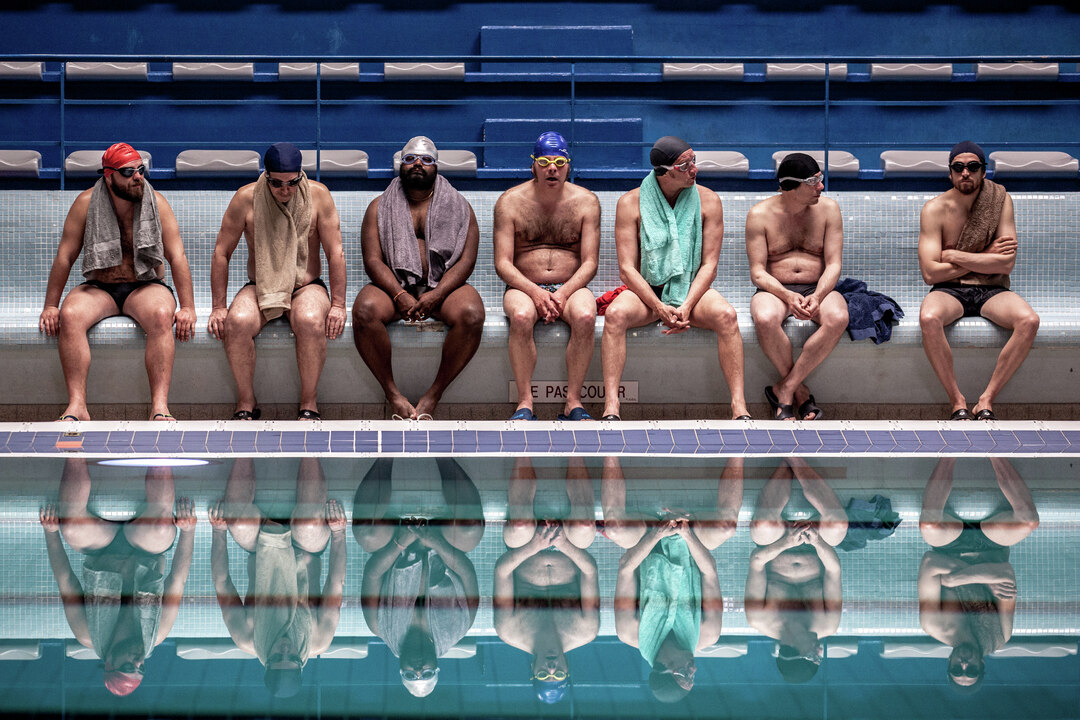
 Image courtesy of France Channel
Le Grand Bain is ostensibly a comedy about a group of middle-aged men who form an unlikely synchronised swimming team. But beneath its familiar premise of male friendship and second chances, the film offers a more interesting analysis of masculinity: it asks what happens when men are removed from the environments in which masculinity is normally performed and placed in a space where vulnerability, cooperation, physical awkwardness, and aesthetic expression become unavoidable.
The swimming pool is therefore more than the setting of the film. It functions as a social laboratory. In most representations of masculinity, the male body is associated with control, strength, competition, and utility. The men of Le Grand Bain, by contrast, enter the water precisely because these qualities have failed them. They are unemployed, divorced, professionally frustrated, emotionally isolated, or simply uncertain about their place in the world. Their bodies do not embody conventional masculine success. They are bodies that have become difficult for their owners to inhabit.
This is what makes synchronised swimming such an effective device. The activity appears almost comically incompatible with traditional ideas of masculinity. It requires coordination rather than dominance, synchronisation rather than individual achievement, grace rather than brute force. Most importantly, it requires the participants to be visibly dependent on one another. A synchronised swimming routine cannot be performed through individual heroism. Its success depends upon bodies surrendering some degree of autonomy in order to produce a collective form.
The film's comedy emerges from precisely this collision between masculine identity and feminine-coded performance. The men are initially uncomfortable with the costumes, choreography, physical exposure, and perceived absurdity of what they are doing. Their embarrassment is not simply about swimming. It reflects a deeper anxiety about being seen performing something that does not confirm their gender identity. The joke, however, gradually changes direction. At first, the men are funny because they look ridiculous doing synchronised swimming. Eventually, they become compelling because the film asks why we ever considered the activity ridiculous in the first place.
In this respect, Le Grand Bain participates in a broader rethinking of masculinity. The film does not argue that traditional masculine qualities should simply be rejected. Rather, it exposes their limitations. Strength, competitiveness, independence, and emotional restraint are useful forms of social capital in certain environments, but they become liabilities when the central problem is loneliness. The men do not need to become stronger versions of themselves. They need to become more capable of depending on other people.
The collective is consequently more important than any individual transformation. The swimming team becomes a substitute institution for men whose conventional institutions have failed them. Work, marriage, family, and professional status are all unstable sources of identity in the film. The team provides something different: belonging without requiring achievement. Its members are valued not because they are successful but because they show up, participate, and make space for one another.
This is where the film's apparent simplicity becomes more politically interesting. The crisis experienced by its characters is not presented solely as personal failure. It is connected to a particular social model in which adult male identity is heavily dependent on productivity. To lose one's job, one's economic independence, or one's position within a family is therefore to lose more than income or status. It can mean losing the narrative through which one understands oneself as a man. The pool provides an alternative narrative: you can be useless at something and still belong somewhere.
The film is also unusually attentive to the body as a site of social judgment. These are not idealised cinematic bodies. They are older, imperfect, sometimes overweight bodies, bodies that carry visible evidence of age and disappointment. Yet the choreography transforms them. Not by making them conventionally attractive, but by making them expressive. The body ceases to be an object that must demonstrate masculine competence and becomes an instrument through which the group communicates.
That transformation is central to the film's emotional argument. The men initially experience their bodies as evidence of decline. Through the team, they discover that the body can instead become a source of possibility. Swimming does not restore their youth; it gives them a different relationship to ageing. They are not attempting to become young men again. They are learning that middle age does not have to mean the disappearance of desire, friendship, ambition, or pleasure.
The film's treatment of failure is equally significant. Contemporary culture tends to interpret failure individualistically: if someone loses a job, a relationship, or a sense of direction, the implication is that something went wrong within the individual. Le Grand Bain offers a different model. Failure becomes socially productive when it is shared. The characters' weaknesses are precisely what allow them to recognise one another. Their collective identity emerges not from excellence but from mutual inadequacy.
This is why the climactic competition matters less as a sporting event than as a ritual of recognition. The objective is not really to win. The performance demonstrates that these men have created something that did not previously exist: a community in which they can be vulnerable without becoming socially insignificant. The choreography is therefore a visible representation of the relationships they have developed. Each movement depends on another body being where it is supposed to be. Trust becomes physical.
There is, of course, an element of fantasy to this resolution. The film risks suggesting that friendship and collective activity can repair structural problems that are considerably larger than the individuals experiencing them. Unemployment, economic insecurity, marital breakdown, and ageing cannot simply be choreographed away. But the film's strength is that it does not entirely pretend otherwise. Its optimism is modest. It does not promise that the characters' lives will become successful in conventional terms. It suggests something more fundamental: that a life can become more bearable when its definition of success changes.
Ultimately, Le Grand Bain is less a film about synchronised swimming than about the possibility of escaping a narrow definition of masculinity. The pool becomes a space in which men can temporarily suspend the demand to be powerful, productive, independent, and emotionally self-sufficient. In doing so, they discover that vulnerability is not the opposite of masculine solidarity; it can be the foundation of it.
The film's deepest irony is that the activity initially perceived as ridiculous becomes the most serious thing these men do. They enter the water expecting to escape their failures, but what they find is a different conception of adulthood: one in which dignity does not depend upon winning, bodies do not have to conform to ideals, and masculinity does not have to be performed through domination.
The final achievement of Le Grand Bain is therefore not that these men learn to swim together. It is that they learn to be seen together. And in a culture that so often teaches men to conceal weakness until it becomes isolation, that may be the more radical form of synchronisation.