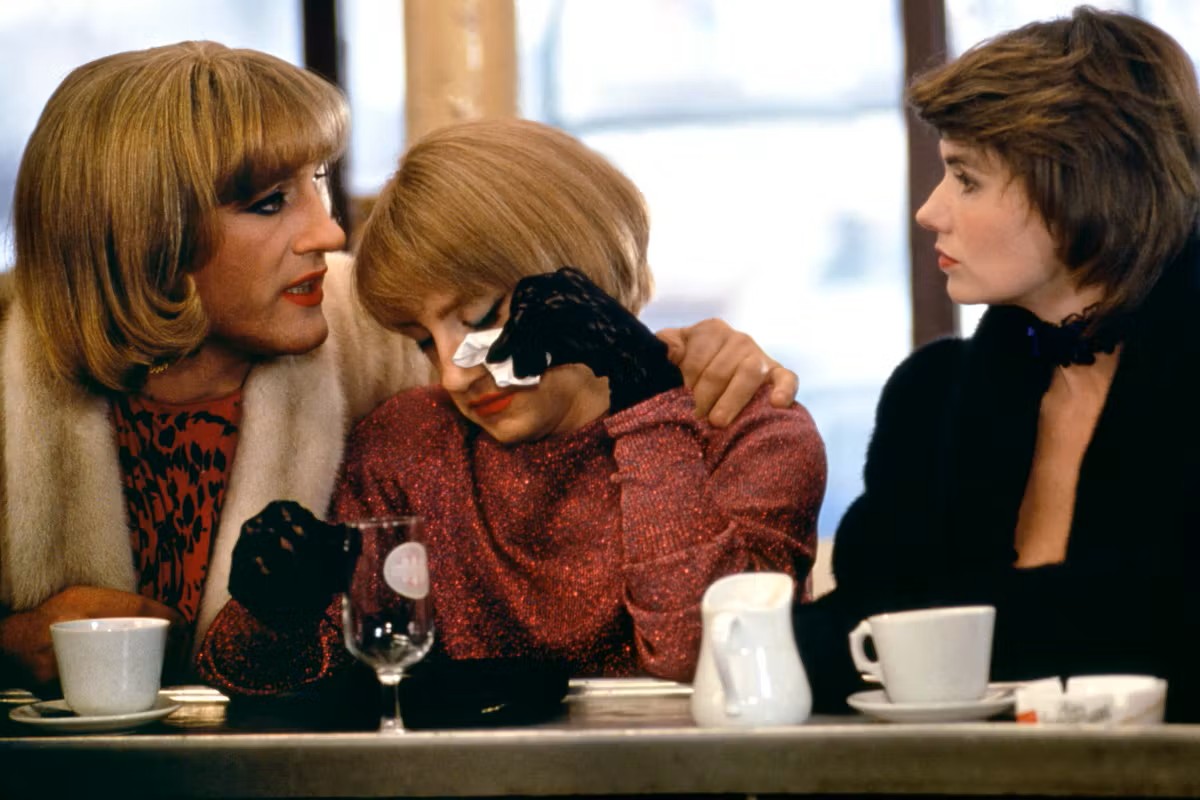
 Image courtesy of France Channel, “Tenue de soirée,” (1986)
When Tenue de soirée premiered at the Cannes Film Festival in 1986, it arrived at a moment when French cinema was renegotiating its relationship with provocation. The explosive radicalism of the 1970s had cooled into something more ambiguous by the mid-80s—less overtly political, perhaps, but no less interested in unsettling audiences. Bertrand Blier had already built a reputation for precisely this kind of discomfort, and Tenue de soirée felt like both a continuation and a refinement of his project: a film that disorients not through shock alone, but through tone, humor, and the quiet erosion of moral certainty.
On its surface, the premise is deceptively simple. A bored, unhappy couple—played by Miou-Miou and Michel Blanc—find their lives upended by the arrival of a charismatic criminal, played by Gérard Depardieu. What unfolds is not just a crime story or a love triangle, but something far stranger: a drifting, unstable configuration of desire that resists easy categorization. Blier isn’t interested in labeling relationships or resolving tensions; instead, he lets them mutate. Sexuality in Tenue de soirée is fluid, opportunistic, and often transactional, but it’s also oddly tender, even as it destabilizes the characters’ identities.
This is where the film’s real significance lies, especially in the context of its Cannes debut. In 1986, representations of bisexuality—particularly male bisexuality—remained rare and often caricatured in mainstream cinema. Blier approaches it obliquely, without turning the film into a statement piece. There’s no didactic framing, no attempt to explain or justify what the characters feel. Instead, desire simply is—irrational, inconsistent, and frequently at odds with social norms. That refusal to moralize or clarify gives the film its uneasy power. It invites interpretation without ever settling into one.
Cannes, by that point, had already developed a reputation for embracing films that hovered between art and controversy, and Tenue de soirée fit neatly into that lineage. But its reception also reflects a shift in what counted as provocative. Unlike the outright scandals of earlier decades, the film didn’t rely on explicit transgression alone. Its disruption was tonal: a blend of deadpan comedy, emotional detachment, and sudden vulnerability that left audiences unsure how to respond. Was it farce? Tragedy? Social critique? Blier refuses to decide, and that refusal becomes the point.
Michel Blanc’s performance, which earned him Best Actor at Cannes, is crucial here. Known largely for comedic roles, Blanc brings a kind of anxious fragility to his character, making his transformation—both emotional and sexual—feel less like a narrative twist and more like a gradual unraveling. Opposite him, Gérard Depardieu exudes a physical and emotional confidence that borders on mythic, anchoring the film even as it drifts into ambiguity. The dynamic between them is less about opposition than absorption; identities blur, roles shift, and the film quietly dismantles the idea that people are fixed or knowable.
Looking back from 2026, what’s striking about Tenue de soirée is how contemporary it still feels in its treatment of desire and identity. While its style is unmistakably of its time—rooted in the rhythms and textures of 1980s French cinema—its themes anticipate later conversations about fluidity and the instability of categories. And yet, it doesn’t feel programmatic or ahead-of-its-time in a self-conscious way. If anything, it feels indifferent to such labels, which may be why it has endured.
Within the broader history of Cannes, the film occupies an interesting middle ground. It lacks the outright notoriety of earlier festival scandals, but it also resists the polished prestige that would come to define many later selections. Instead, it sits in that transitional space where Cannes was becoming more global and media-savvy, yet still deeply committed to films that unsettled rather than reassured. Tenue de soirée doesn’t announce itself as important; it simply behaves as if conventional rules don’t apply—and trusts the audience to sit with the consequences.
That, ultimately, may be its most Cannes-like quality. It doesn’t seek consensus. It lingers, irritates, and quietly rearranges the terms of what a relationship—or a film—can look like.