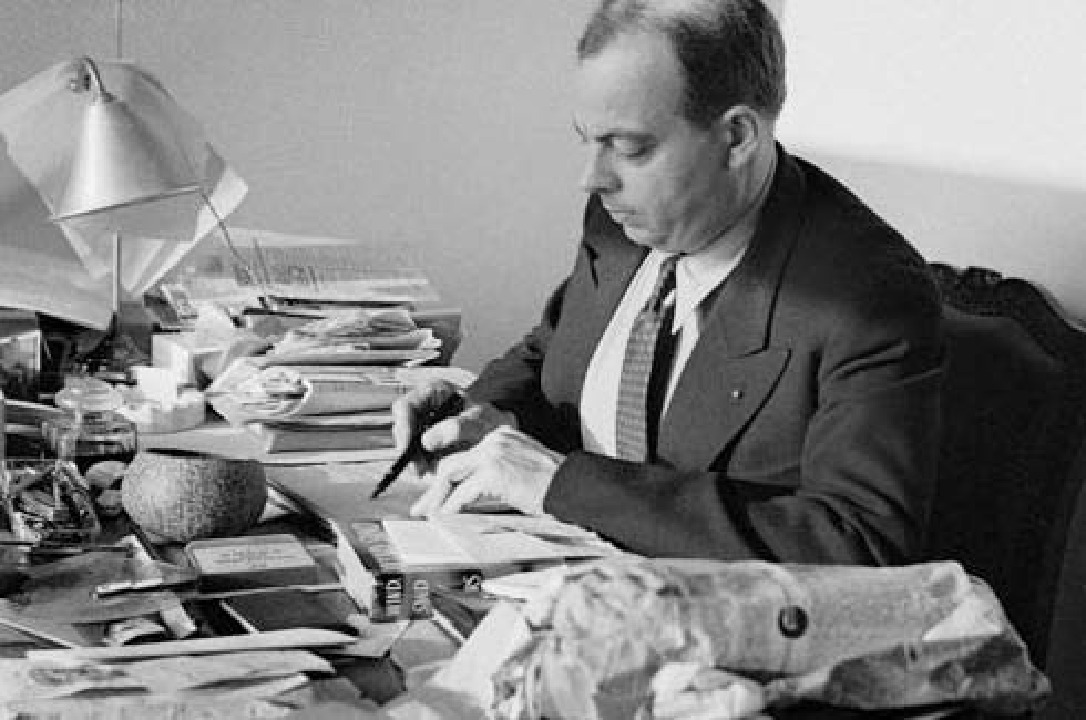
 Image courtesy of France Channel, “Saint-Euxpéry: The Last Romantic” (2016)
Saint-Exupéry: The Last Romantic is less a conventional documentary than an exercise in interpretation: it constructs Antoine de Saint-Exupéry not simply as a historical figure, but as a coherent aesthetic argument about modernity, solitude, and the limits of rational experience. Rather than presenting his life as a sequence of events to be understood causally, the film organizes it around a persistent tension between technological modernity and what it frames as an older, almost pre-modern form of perception—one in which meaning is derived from attention, risk, and subjective intensity.
At the center of this construction is Antoine de Saint-Exupéry, who is presented not as a stable subject but as a figure defined by structural contradiction. The documentary repeatedly emphasizes that he was simultaneously an aviator embedded in the expanding logistical systems of early aviation and a writer fundamentally suspicious of the reduction of human experience to efficiency. This tension is not treated as incidental biography; instead, it functions as the film’s organizing principle. Flight, in this reading, is not merely a profession but a philosophical condition: a space in which human perception is forced into confrontation with scale, distance, and fragility.
The film’s central claim is that Saint-Exupéry’s so-called “romanticism” is best understood not as sentimentality, but as a resistance to epistemic closure. Romanticism here becomes a mode of cognition rather than an emotional register. The desert, the night sky, and the cockpit are repeatedly framed as environments that strip away social redundancy and force an encounter with essential perception. In this sense, the documentary aligns his worldview with a critique of modern rationalism: the more the world becomes systematized, the more meaning migrates into marginal, unstable, and experiential spaces.
This argument is most clearly articulated through the film’s treatment of The Little Prince. Rather than reading the text as a simple allegory of innocence, the documentary situates it as a late-stage condensation of Saint-Exupéry’s epistemology. The key analytical move here is to interpret the novella not as a retreat into childhood simplicity, but as a response to cognitive exhaustion produced by modern adulthood. The “child” figure is therefore not opposed to knowledge, but to instrumental reason; he represents a different hierarchy of relevance, in which meaning is determined by relational significance rather than empirical utility. The film’s argument implies that the apparent simplicity of the text is itself an intellectual refusal—a rejection of complexity that no longer yields meaning.
Formally, the documentary reinforces this thesis through its structure. It relies heavily on archival fragmentation, voiceover discontinuities, and extended sequences of environmental sound, particularly wind, engine noise, and radio static. These elements are not merely atmospheric; they function as an aesthetic analogue to Saint-Exupéry’s own epistemic position. The viewer is denied a stable narrative trajectory, which mirrors the instability of aerial perception itself, where orientation is always partial and mediated. In this sense, the film’s style is not decorative but argumentative: it performs the dislocation it attributes to its subject.
The most significant interpretive choice the documentary makes concerns Saint-Exupéry’s disappearance in 1944 during a reconnaissance mission. Rather than treating this event as an unresolved historical puzzle, it frames it as the logical culmination of a life organized around dissolution into space and movement. Disappearance of Antoine de Saint-Exupéry is therefore not positioned as narrative rupture but as thematic resolution. The film resists speculative closure because closure would contradict its central claim: that Saint-Exupéry’s life is best understood as a sustained negotiation with disappearance as both physical risk and metaphysical horizon.
Ultimately, the documentary’s argument is that Saint-Exupéry should be read less as an individual author or pilot and more as a diagnostic figure for a transitional historical moment. He embodies a condition in which modern technological systems expand human reach while simultaneously eroding stable frameworks of meaning. His “romanticism,” in this interpretation, is not nostalgia for a pre-modern past, but an attempt to preserve intensity of perception within an increasingly abstract world. The film’s final effect is therefore not to recover Saint-Exupéry as a biographical subject, but to use him as a lens through which to examine the costs of modern abstraction itself.
If anything, what lingers is not the man, but the model: a life lived at altitude, where clarity and disappearance are structurally indistinguishable.