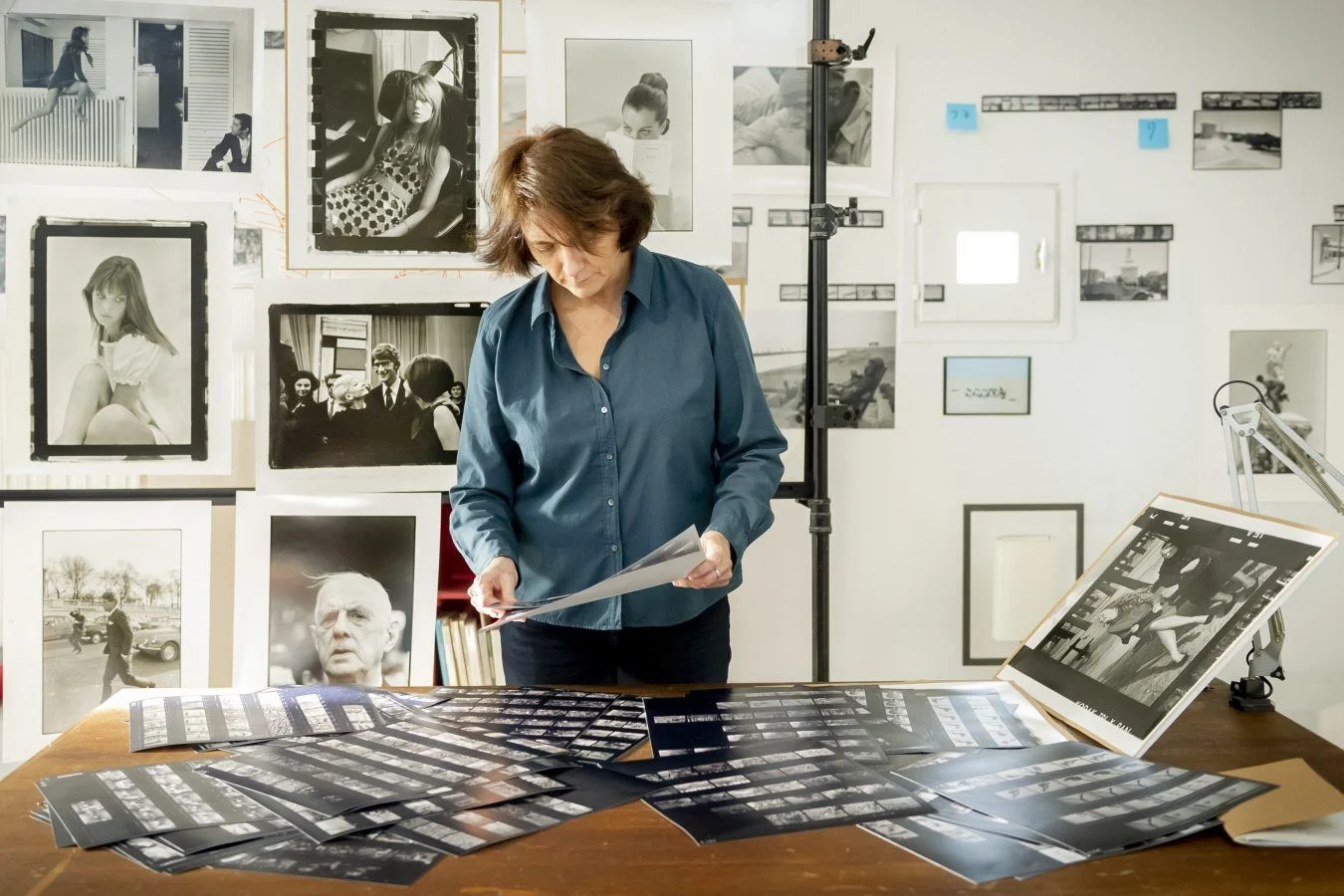
 Image courtesy of France Channel, “Histoire d’un regard” (2019)
The work of Gilles Caron and the documentary Looking for Gilles Caron by Mariana Otero together form a meditation on one of the most elusive dimensions of photography: the search for the image. This search is not simply a matter of technique or composition; it is a way of being in the world, a restless movement toward something that can never be fully grasped. Through Caron’s photographs and Otero’s reconstruction of his gaze, photography appears less as the act of capturing reality than as an ongoing pursuit shaped by absence, risk, and desire.
Caron’s career, though remarkably brief, was marked by an intense proximity to history. From the upheavals of May 1968 in France to the violence of international conflicts, he placed himself in situations where the world seemed to be in the process of transforming. Yet what distinguishes his work is not simply the events he documented, but the way he moved within them. His images suggest a photographer who does not wait for the world to present itself clearly, but who actively searches within it for a moment that crystallizes meaning. This search is visible in the tension of his photographs: gestures are suspended, bodies caught mid-action, expressions hovering between clarity and ambiguity. The image, in this sense, is never fully given—it is wrested from the flow of time.
The documentary deepens this understanding by shifting attention away from the finished photograph toward the process that precedes and follows it. Rather than isolating iconic images, Otero returns to contact sheets, to sequences of frames that reveal hesitation, adjustment, and movement. In doing so, she dismantles the myth of the decisive moment as a singular instant of mastery. What emerges instead is a more fragile and uncertain process, in which the photographer navigates a field of possibilities, never entirely sure where the image will appear. The act of photographing becomes inseparable from duration, from the time it takes to look, to approach, to decide.
This temporal dimension is inseparable from the film’s central absence: Caron himself. His disappearance in Cambodia in 1970 casts a shadow over both his work and the documentary that seeks to reconstruct it. The title Looking for Gilles Caron suggests an investigation, but it is an investigation that cannot reach its object. What remains are images—thousands of them—yet the gaze that produced them cannot be fully recovered. This gap between presence and absence transforms the search for the image into something more paradoxical. Each photograph bears the trace of the photographer, yet never enough to reconstitute him entirely. To look at Caron’s images is therefore also to confront what is missing, what escapes both the camera and the archive.
Otero’s film embraces this absence rather than attempting to resolve it. By lingering on sequences, by reconstructing movements from still frames, she reveals that meaning often resides not within the image itself but in the spaces between images. These intervals—moments before and after the shutter clicks—suggest a continuity that photography can only fragment. The image appears, then, as both revelation and limitation: it shows something, but it also marks the boundary of what cannot be shown. In this way, the search for the image becomes inseparable from an awareness of its impossibility. The photographer seeks a form of presence that always remains just out of reach.
This tension is particularly evident in Caron’s war photography. To photograph conflict is not only to document events, but to negotiate a position in relation to them. Caron’s images do not simply present violence; they seem to search for a human dimension within it, for a moment in which the abstraction of history gives way to individual experience. Yet this search is ethically complex. To look is already to frame, to select, to transform. The photographer is both witness and interpreter, caught between the necessity of showing and the risk of reducing reality to an image. In this sense, the search for the image is also a search for a just way of seeing.
Cinema, in Otero’s hands, becomes a means of extending this search. By animating still photographs and reintroducing them into a temporal flow, the film attempts to restore something of what photography interrupts. But this restoration is necessarily incomplete. The movement created by the film does not erase the gaps; it makes them perceptible. The viewer becomes aware not only of what is shown, but of what lies beyond the frame, of the continuity that no image can fully contain. The documentary thus mirrors Caron’s own practice: it is itself a search, one that advances through fragments without ever achieving total coherence.
What ultimately emerges from this encounter between photographer and filmmaker is a conception of the image as something fundamentally unresolved. The image is not an endpoint, not a definitive statement about the world. It is a moment within a larger process, a provisional answer to a question that remains open. For Caron, this question was inseparable from movement, from the need to go closer, to see differently, to risk uncertainty. For Otero, it becomes a question addressed to the past, to an absent figure whose work continues to resonate precisely because it resists closure.
In this light, the search for the image can be understood as a form of desire—an impulse that drives the photographer forward without ever being fully satisfied. Each image is both a discovery and a reminder of what has not been found. Caron’s disappearance gives this dynamic a poignant finality: his search was interrupted, but not concluded. The images remain as traces of that movement, fragments of a gaze that continues to invite interpretation. To look at them is to participate, in some sense, in the same search—to seek, within the visible, the elusive presence that always exceeds it.