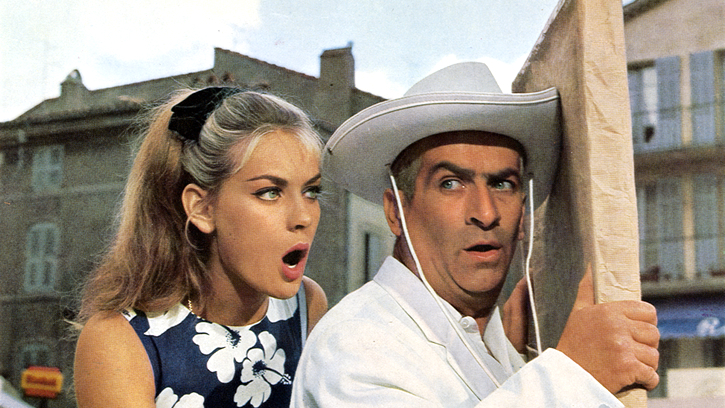
 Image courtesy of France Channel, “Le Gendarme de Saint-Tropez” (1964)
There are certain film series that endure because they are considered masterpieces, and then there are those that endure because they understand people. The Gendarme series, beginning with The Troops of St. Tropez, belongs firmly in the second category. To contemporary viewers, these films can initially appear like relics of another era: broad physical comedy, exaggerated performances, and a vision of French society that feels distant from modern life. The uniforms, the pacing, and many of the social norms reflect the 1960s and 1970s more than the 2020s. Yet what is striking about revisiting the series today is not how dated it feels, but how familiar its underlying tensions remain.
At the center of the films is the character of Ludovic Cruchot, played by Louis de Funès. Cruchot is ambitious, rule-obsessed, impatient, and constantly convinced that order can be imposed on chaos if only people would follow regulations properly. The world around him, however, refuses to comply. This mismatch between institutional certainty and lived reality is the engine of every film in the series. New technologies appear, social customs evolve, tourists flood in, and authority is repeatedly tested by changing behaviour. Cruchot’s frustration becomes the comedic focal point, but it also reflects something deeper about how institutions respond to change.
Seen through a modern lens, this dynamic feels surprisingly contemporary. The gap between systems and reality has only widened in the decades since the films were made. Governments struggle to regulate technologies they do not fully understand, cities attempt to manage tourism at scales that strain infrastructure, and institutions across society are forced to adapt to shifting expectations faster than they can comfortably manage. The specifics have changed, but the underlying anxiety remains the same: the sense that rules and structures are always slightly behind the world they are meant to govern.
Saint-Tropez itself is also central to the series’ continued relevance. In the 1960s, it was already becoming a symbol of leisure culture and international tourism, representing a new kind of European coastal identity shaped by mobility and spectacle. Today, that process has intensified across countless destinations, from Mediterranean resort towns to major European cities. The films, in their own comedic way, capture the early stages of a transformation that has since become global. They quietly observe a place negotiating between local life and external attention, between tradition and commercialisation, between everyday routine and performance for visitors.
Another reason the series still resonates lies in its portrayal of bureaucracy. Rather than depicting institutions as purely efficient or coldly rational, the films present them as deeply human systems. Rules are inconsistently applied, communication breaks down, personal rivalries influence decisions, and small misunderstandings escalate into larger problems. In this sense, the gendarmes are not symbols of flawless authority but of institutional improvisation. The comedy emerges from the gap between how systems are supposed to work and how they actually function when operated by imperfect people.
This extends to the films’ treatment of authority itself. While the protagonists are police officers, they are rarely depicted as fully competent or all-seeing. Instead, they are frequently confused, undermined by circumstances, and forced to adapt in real time. The audience is invited to laugh both at and with them, creating a tone that feels more ambivalent toward authority than one might expect from mid-century popular cinema. In hindsight, this reflects a surprisingly modern sensibility: a recognition that institutions are fallible and that authority is often improvised rather than absolute.
Of course, not all aspects of the series have aged evenly. Certain jokes and characterisations reflect social attitudes specific to their time and may feel dated or uncomfortable to modern audiences. However, reducing the films to these elements alone risks overlooking what has allowed them to persist culturally. Their enduring strength lies less in their surface humour than in their observation of social friction: the way societies respond to change, the way institutions attempt to preserve order, and the way individuals cling to rules when the world becomes uncertain.
Ultimately, the continued relevance of the Gendarme series lies in its central paradox. It depicts a world that is constantly changing while its protagonist remains convinced that stability can be enforced through discipline and regulation. That tension between change and control, between improvisation and order, has not diminished with time. If anything, it has become more recognisable in contemporary life. The films may belong to another era aesthetically, but their underlying insight—that people and institutions are perpetually trying, and often failing, to keep up with the pace of change—feels unmistakably current.