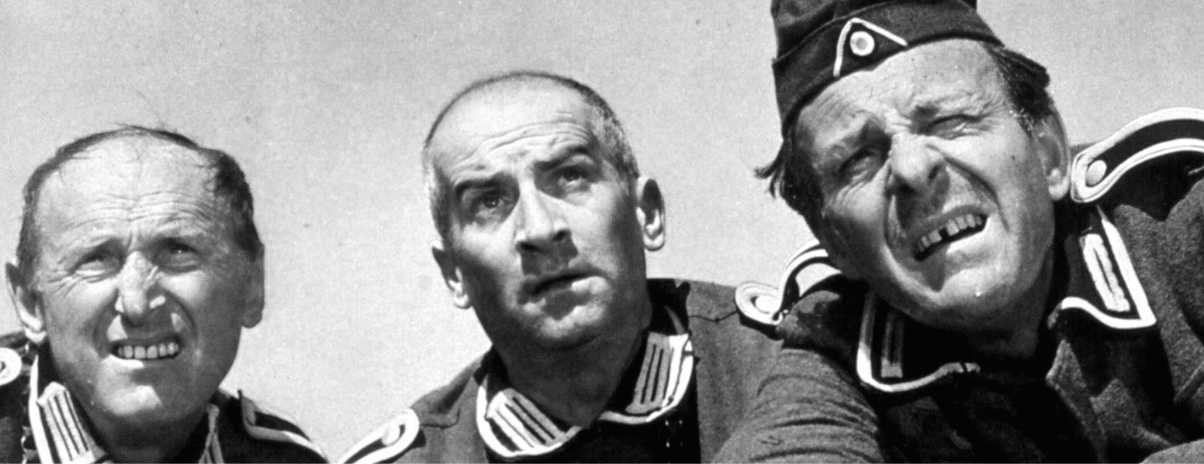
 Image courtesy of France Channel, “La Grande Vadrouille” (1966)
France and Britain are separated by only a few dozen miles of water, but their comedic traditions can sometimes seem to come from entirely different worlds. British humour is often associated with understatement, irony, absurdity and self-deprecation, while French humour has frequently been characterised by wordplay, satire, physical comedy and a willingness to engage directly with social and political subjects. These distinctions can be useful, but they should not be treated as absolute rules. Neither "French humour" nor "British humour" is a single, unified tradition. Both countries have enormous regional, generational and stylistic differences, and comedians regularly borrow techniques from across national boundaries. Nevertheless, comparing the two traditions reveals some fascinating differences in how comedy operates.
The British art of understatement
One of the most recognisable features of British comedy is understatement. A dramatic or ridiculous situation may be met with an apparently calm observation rather than an emotional reaction. The humour comes partly from the contrast between what has happened and the restrained way in which somebody describes it. This tradition can be seen across British television and literature, from the dry observations of classic sitcoms to the absurdity of shows such as The Office, Peep Show and The Thick of It.
The joke is not necessarily announced. Instead, the audience is expected to recognise the gap between what a character says and what they actually mean. Irony is therefore particularly important. A statement can mean almost the opposite of its literal meaning, with tone and context doing much of the work. This can occasionally create difficulties for people unfamiliar with British conversational conventions. A British speaker saying "That's not ideal" may, depending on the circumstances, mean that something has gone catastrophically wrong.
French humour and the pleasure of wordplay
French comedy also makes extensive use of irony, but another particularly important feature is language itself. French has a long tradition of jeux de mots — puns and linguistic games in which the sound or meaning of words becomes part of the joke. French comedians and writers frequently exploit ambiguity, double meanings and unexpected associations.
This linguistic tradition is particularly visible in French theatre, literature, radio and television. The pleasure can come from the construction of the phrase itself, rather than simply from the situation in which it is delivered. That creates one of the biggest challenges when French humour is translated into English: a joke based on the sound or double meaning of a French expression may simply cease to work.
The reverse is equally true. British humour often depends heavily on tone, understatement and cultural context, all of which can be difficult to reproduce in another language.
Self-deprecation versus comic self-confidence
Another frequently observed difference concerns the treatment of the self. British humour has a particularly strong tradition of self-deprecation. Making oneself the target of the joke can function as a way of establishing social ease. Someone who makes fun of their own mistakes can demonstrate that they do not take themselves too seriously.
This does not mean that French humour lacks self-deprecation. French comedians frequently make themselves the subject of jokes, and self-mockery is hardly exclusively British. The difference is perhaps more accurately understood as one of emphasis and convention. British social humour has historically placed considerable value on appearing modest and avoiding excessive self-importance, making self-deprecation a particularly familiar comic device.
French comedy, meanwhile, can be more comfortable with exaggeration and theatricality. A comic character may deliberately draw attention to their own personality, vanity or eccentricity rather than minimising it.
The absurd and the surreal
Both cultures have extraordinary traditions of absurd humour. Britain gave the world Monty Python, whose influence on international comedy is difficult to overstate. The Pythons combined surreal situations, linguistic absurdity, historical parody and deliberately illogical narratives. France has its own extensive tradition of absurdity and surrealism, with roots extending through literature, theatre and cinema. French comedy has often embraced characters behaving irrationally, situations escalating beyond plausibility and ordinary social conventions being turned upside down.
This is one area where the two traditions overlap considerably. The difference is often less about whether absurdity exists and more about how it is deployed. British absurdism frequently creates comedy through deadpan reactions to increasingly ridiculous circumstances. French comic traditions have often allowed the absurdity itself to become more visibly theatrical.
Physical comedy: a shared language
If there is one form of comedy that can cross the Channel without translation, it is physical comedy. British cinema and television have produced iconic physical comedians, from Charlie Chaplin's early British career to later performers such as Rowan Atkinson. France has an equally distinguished tradition. Louis de Funès is perhaps the clearest example. His extraordinary facial expressions, frantic movements and escalating frustration made his performances comprehensible even when language became secondary.
Films such as La Grande Vadrouille demonstrate how physical comedy can bridge cultural differences. Much of the humour depends upon movement, timing and visual absurdity rather than sophisticated dialogue. Physical comedy therefore provides an interesting counterpoint to the stereotype that French and British humour are fundamentally incompatible. Some comic techniques are remarkably universal.
Social satire
Both French and British comedy have long traditions of satire, but their targets and styles can differ. British comedy has frequently used institutions as objects of ridicule. Politicians, the civil service, the monarchy, the class system, schools, workplaces and the media have all provided material. Series such as Yes Minister, The Thick of It and Blackadder demonstrate how British comedy can use fictional situations to satirise political and social structures.
French comedy similarly has a long history of satirising politicians, institutions, social classes and cultural conventions. Political humour is particularly visible in French cartoons, newspapers, television and stand-up comedy. The two traditions therefore share a willingness to question authority. What differs is often the comic vocabulary used to do so.
British irony and French satire
A useful — though inevitably simplified — distinction is that British comedy often invites the audience to recognise an incongruity without explicitly explaining it, whereas French satire may be more direct in identifying the social contradiction it wants to expose. Consider the difference between two hypothetical jokes.
A British comic might describe an absurd government decision and simply observe, "Well, that went rather well."
A French comic might instead construct an elaborate satire around the politician responsible, exaggerating their behaviour until the contradiction becomes unmistakable.
Neither approach is inherently more subtle or more intelligent. They simply place the emphasis in different places: one on understatement and implication, the other on exaggeration and exposure. And, of course, many comedians in both countries do both.
The importance of context
One of the biggest reasons French and British humour can occasionally be difficult to understand across cultures is that comedy relies heavily on shared assumptions. British humour can depend on recognising a particular social convention, accent, class reference or cultural institution. French humour can similarly rely on knowledge of political personalities, linguistic nuances, television culture or historical references. This means that a joke can be perfectly comprehensible linguistically while remaining culturally opaque.
Someone learning French may understand every word in a French comedy routine and still miss the joke. The same can happen to a French-speaking viewer watching a British sitcom. Understanding humour therefore involves learning much more than vocabulary. It means learning what a culture considers ridiculous.
Different attitudes towards embarrassment
Another interesting distinction concerns embarrassment. British comedy frequently derives humour from social awkwardness. Characters say the wrong thing, misunderstand social expectations or make themselves look foolish in front of others. The Office is an especially famous example of this tradition.
The audience is often made to feel the discomfort alongside the character. French comedy certainly uses embarrassment too, but it frequently combines it with more overt theatricality. A character's humiliation can become part of a larger comic performance involving exaggerated gestures, confrontation and escalating chaos.
Again, this is a tendency rather than a rule. Contemporary French and British comedy increasingly borrow from the same international comic vocabulary.
What both traditions have in common
Despite all these differences, the similarities between French and British humour may ultimately be more important than the contrasts. Both traditions value clever language. Both use irony. Both enjoy absurdity. Both have long histories of political and social satire. Both produce sophisticated literary comedy as well as broad popular entertainment. And both have developed comic traditions in which ordinary social behaviour becomes an object of fascination.
There is also a shared willingness to make fun of national stereotypes. French people can joke about the French. British people can joke about the British. And both cultures have developed extensive repertoires of jokes about one another.
Indeed, Franco-British relations themselves have frequently provided comic material. The differences between the two countries — accents, food, manners, politics, bureaucracy and attitudes towards social behaviour — can become a source of affectionate humour precisely because the two cultures know one another so well.
Comedy as cultural translation
Perhaps the most interesting lesson from comparing French and British humour is that comedy can reveal cultural differences more clearly than almost any other form of art. A historical event can be translated. A landscape can be photographed. A recipe can be recreated. But a joke depends on an audience understanding not only the words but the assumptions behind them.
That is why watching comedy from another country can be such an illuminating cultural experience. A British viewer watching French comedy may discover different attitudes towards authority, language, family, romance or social status. A French viewer watching British comedy may become more aware of the importance of understatement, awkwardness, irony and self-deprecation in British culture.
And sometimes the joke that seems incomprehensible at first becomes much funnier once the cultural reference is understood.
Two traditions, plenty of overlap
Ultimately, there is no single definition of either French or British humour.
French comedy can be subtle, understated and self-deprecating. British comedy can be loud, physical and theatrical. French comedians can use deadpan irony, while British comedians can build entire routines around wordplay. The stereotypes work only as starting points, not as definitive descriptions. What can reasonably be said is that the two traditions have developed different emphases.
British humour often makes comedy out of understatement, irony, awkwardness and self-deprecation, while French humour has particularly strong traditions of wordplay, satire, exaggeration and theatrical physical comedy. But both cultures share an appetite for absurdity, social observation and the comic possibilities of everyday life.
Perhaps that is why French and British audiences can sometimes find each other's humour both strange and immediately recognisable. The joke may cross the Channel differently, but it still crosses it.
And in a relationship between two neighbouring cultures with such a long history of rivalry, exchange and friendship, that ability to laugh at — and with — one another may be one of the most enduring forms of cultural connection.