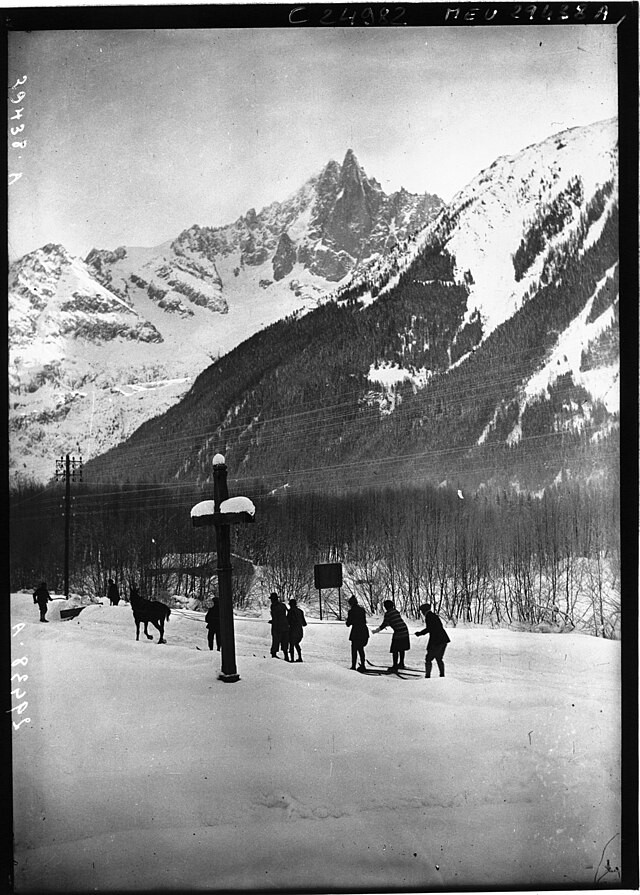
 Image courtesy of Wikimedia Commons, Chamonix 1926
The Olympic flame burns brightly — and briefly. Stadiums roar, medals are awarded, flags are raised. And then, almost overnight, the spectacle disappears.
But what happens after the crowds leave?
In France, the Winter Olympic Games have not vanished into memory. In Chamonix (1924), Grenoble (1968), and Albertville (1992), the Olympic villages and venues did not become ghost towns. Instead, they were absorbed — imperfectly, sometimes quietly — into daily life.
The legacy of the Winter Games in France is not only found in record books. It lives in apartment buildings, ski lifts, suburban neighborhoods, and modernist architecture softened by decades of Alpine weather.
Chamonix 1924: Modesty That Aged Gracefully
The first Winter Olympics in 1924 were small in scale. Chamonix did not build monumental villages designed to impress the world. Infrastructure was practical, intimate, and woven into the town itself.
Today, much of what hosted the Games feels organic rather than preserved. The original Olympic stadium site remains part of the town’s sports complex. Ice rinks and ski areas evolved naturally as tourism expanded throughout the 20th century.
There is no abandoned grandeur here. Instead, the Olympic legacy blends seamlessly with Chamonix’s identity as a year-round mountain destination.
In many ways, the town’s modesty ensured its longevity. Nothing was overbuilt. Nothing feels stranded in time. The 1924 Games became part of Chamonix rather than overshadowing it.
Grenoble 1968: Concrete, Optimism, and Urban Experiment
Grenoble’s Winter Olympics in 1968 told a very different story. Held during a period of technological optimism under President Charles de Gaulle, the Games symbolized modern France — efficient, forward-looking, and ambitious.
The Olympic Village in Grenoble was constructed as a bold urban project: large residential blocks designed to house athletes and later transition into permanent housing.
And that is precisely what happened.
Today, the Village Olympique remains a lived-in neighborhood. Families occupy the same buildings that once housed international competitors. Schools, shops, and parks operate within a district that has fully integrated into the city’s fabric.
Some of the architecture reflects the era’s modernist confidence — geometric lines, concrete façades, expansive planning. Time has weathered these structures, but it has not erased them. Instead, they stand as reminders of a moment when sport and urban design intersected with national ambition.
Grenoble’s Olympic venues — including ski jumps and mountain facilities — were distributed across nearby Alpine sites. Many continue to function, supporting tourism and winter sport culture.
The legacy here is not nostalgic. It is practical, lived, and occasionally debated — particularly as conversations about urban planning and sustainability evolve.
Albertville 1992: The Dispersed Games
By the time Albertville hosted the Winter Olympics in 1992, the model had shifted again. Rather than concentrate all venues in one location, the Games were spread across the Savoie region — Courchevel, Méribel, Les Arcs, La Plagne, and other Alpine resorts.
The Olympic Village itself, located in Brides-les-Bains, transitioned into residential and tourism accommodation after the Games. Many athlete housing complexes were intentionally designed for post-Olympic conversion.
The result? Integration rather than abandonment.
Ski lifts constructed or upgraded for 1992 still carry visitors up the slopes each winter. Ice rinks and competition arenas serve local communities and regional events. Resorts that gained international visibility during the Games continue to thrive as major winter destinations.
Albertville’s legacy is perhaps the most economically enduring. The Olympics accelerated infrastructure — roads, rail links, resort modernization — that permanently reshaped the region’s accessibility.
The spectacle may have lasted weeks. The tourism impact lasted decades.
Architecture as Memory
Across all three host cities, Olympic architecture remains visible — though often quietly.
In Grenoble, modernist towers still frame the skyline. In Albertville, facilities blend into Alpine landscapes. In Chamonix, memory lives more in plaques and heritage markers than in monumental construction.
Unlike some global Olympic sites that struggle with abandoned arenas, France’s Winter Olympic venues largely avoided dramatic decay. Part of this success stems from scale. None of the French Winter Games attempted overwhelming gigantism. The mountains themselves imposed limits.
Nature has a way of insisting on proportion.
The Human Afterlife of the Games
Perhaps the most interesting legacy is not architectural, but human.
Children play in parks that once welcomed Olympians. Residents commute through neighborhoods originally designed for global visitors. Ski instructors train on slopes prepared for medal events decades ago.
The Olympic Villages did not remain frozen in time. They became ordinary — and that ordinariness may be their greatest success.
The Games were extraordinary. The legacy is everyday.
Sustainability and the Future of Winter Sport
Today, as climate change raises questions about snow reliability and mega-event sustainability, the French Winter Olympic sites take on new relevance.
Their relatively restrained scale — especially in 1924 and 1968 — appears almost prescient. They remind us that global spectacle does not have to produce permanent excess.
As France continues to host major sporting events, including the Paris 2024 Summer Olympics, the Alpine experience offers a lesson: build with the future in mind.
Visiting Today
Travelers can still trace Olympic history through the French Alps:
- Walk through Grenoble’s Village Olympique neighborhood.
- Ski slopes used during the 1992 Albertville Games.
- Visit Chamonix’s sports complex near the original 1924 stadium site.
- Explore local museums documenting each event’s legacy.
But what you’ll notice most is not grandeur — it is continuity. The cafés are open. The lifts turn. The apartment windows glow at dusk. Life moved in after the flame went out.