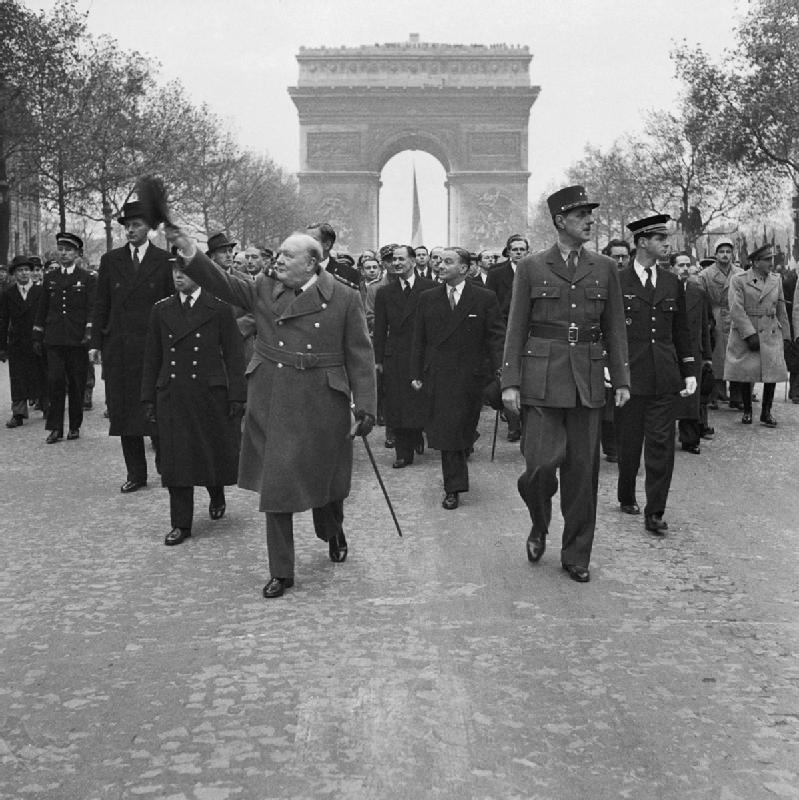
 Image courtesy of Wikimedia Commons: Winston Churchill and Charles De Gaulle on the Champs Elysées, Armistice Day, Nov. 11th, 1944.
Few international relationships have been shaped by such a fascinating mixture of rivalry, admiration, conflict and cooperation as that between France and Britain. Separated by only a narrow stretch of water, the two countries have spent centuries alternately competing with and learning from one another. Their shared history contains wars and imperial rivalries, but it also contains extraordinary examples of diplomacy, cultural exchange and solidarity. Indeed, the story of Franco-British relations can be understood not simply as a history of former enemies becoming friends, but as one of two neighbouring nations gradually discovering how much they have in common.
The relationship begins with conquest and competition. The Norman Conquest of 1066 created connections between England and continental Europe that would profoundly influence English political and cultural life. Over subsequent centuries, England and France became major rivals, most dramatically during the Hundred Years' War. Their competition extended beyond European territory into trade, exploration and empire. Yet even during periods of hostility, ideas, artistic influences, language and people continued to cross the Channel. The relationship was therefore never simply one of opposition: proximity ensured constant interaction.
By the nineteenth century, the possibility of a more cooperative relationship was increasingly apparent. Britain and France remained competitors, particularly in the imperial sphere, but diplomatic and personal contacts began to soften the old antagonisms. The phrase "Entente Cordiale" itself has nineteenth-century origins: in 1843, British Foreign Secretary Lord Aberdeen referred to relations with France in terms of a "cordial good understanding", while French statesmen similarly promoted the idea of a more constructive relationship.
The decisive transformation came in 1904 with the signing of the Entente Cordiale. Rather than being a formal military alliance, the agreements settled a number of longstanding colonial and diplomatic disputes. Britain recognised French interests in Morocco, while France recognised Britain's position in Egypt; other disagreements, including those concerning fishing rights around Newfoundland, were also addressed.
The importance of the Entente Cordiale lies partly in what it represented. Two countries with a long history of rivalry demonstrated that historical grievances did not have to determine the future. The agreement did not erase national differences. Instead, it created a framework in which those differences could coexist with practical cooperation. This makes the Entente an especially interesting example of diplomacy: friendship did not require Britain and France to become alike. The partnership acquired a much deeper significance during the twentieth century. British and French forces fought alongside one another during both World Wars, transforming diplomatic understanding into military cooperation. During the First World War, British forces were deployed to France, while British and French commanders developed increasingly close forms of military coordination. The shared sacrifices of the conflict left a profound mark on both countries and reinforced the idea that their security and prosperity could be interconnected.
The Second World War provided another defining chapter. Following the fall of France in 1940, Britain became a crucial centre for Free French activity, while French and British personnel worked together against Nazi Germany. The relationship was sometimes complicated — alliances between states rarely eliminate disagreement — but the broader partnership survived the immense pressures of war. As later British government reflections on the relationship have noted, the two countries' histories had become deeply intertwined through shared struggle and sacrifice. What makes the Franco-British relationship particularly interesting, however, is that its significance extends beyond diplomacy and warfare. Politics may create treaties, but culture is often what makes international relationships meaningful to ordinary people. French cinema, literature, food, fashion and music have long occupied an important place in British cultural life, while British popular culture, literature and music have similarly influenced France.
The Channel, which might appear to separate the two countries, has therefore frequently functioned as a cultural bridge. Travel, tourism, education, broadcasting and trade have made the physical distance between Britain and France increasingly easy to cross. The result is a relationship in which each country can remain distinctly itself while taking an active interest in the culture of the other. This is particularly significant in the contemporary era. Political relationships inevitably change, and Britain's departure from the European Union has altered the institutional framework within which Britain and France interact. But political structures are only one part of an international relationship. The historical connections between British and French people — through culture, education, tourism, business and the arts — continue to provide a foundation for contact.
In this context, the arrival of French streaming services in Britain is more than simply a development in entertainment. It represents another way in which the Channel can become less of a barrier. The launch of France Channel in the UK in September 2026 gives British audiences a new opportunity to engage directly with French films, television, documentaries and culture from home. The service's arrival is a particularly appropriate development given the long history of cultural exchange between the two countries.
For those interested in exploring contemporary French culture, France Channel is now available in the UK, bringing French-language entertainment to British viewers. To celebrate the UK launch, new subscribers can receive 30% off an annual subscription with the code 30GLFUK.
The significance of Franco-British relations ultimately lies in this ability to transform difference into connection. France and Britain have never been identical societies, nor have they always agreed. Their histories are marked by genuine conflict as well as cooperation. Yet precisely because they are close neighbours with distinct identities, their relationship has produced a remarkable form of cultural dialogue. The Entente Cordiale of 1904 demonstrated that former rivals could establish a durable partnership. The shared experiences of the two World Wars demonstrated the practical strength that such cooperation could acquire. And the continuing movement of films, television, literature, ideas and people across the Channel demonstrates that international friendship is not sustained by governments alone.
The history of France and Britain is therefore not simply a story of two nations looking at one another across the Channel. It is a story of two cultures continually crossing it — sometimes as rivals, sometimes as allies, and increasingly as neighbours with a shared curiosity about one another. From the diplomatic negotiations of the nineteenth and early twentieth centuries to the arrival of French television on British screens today, the Channel has repeatedly proved to be less a dividing line than a route of connection.