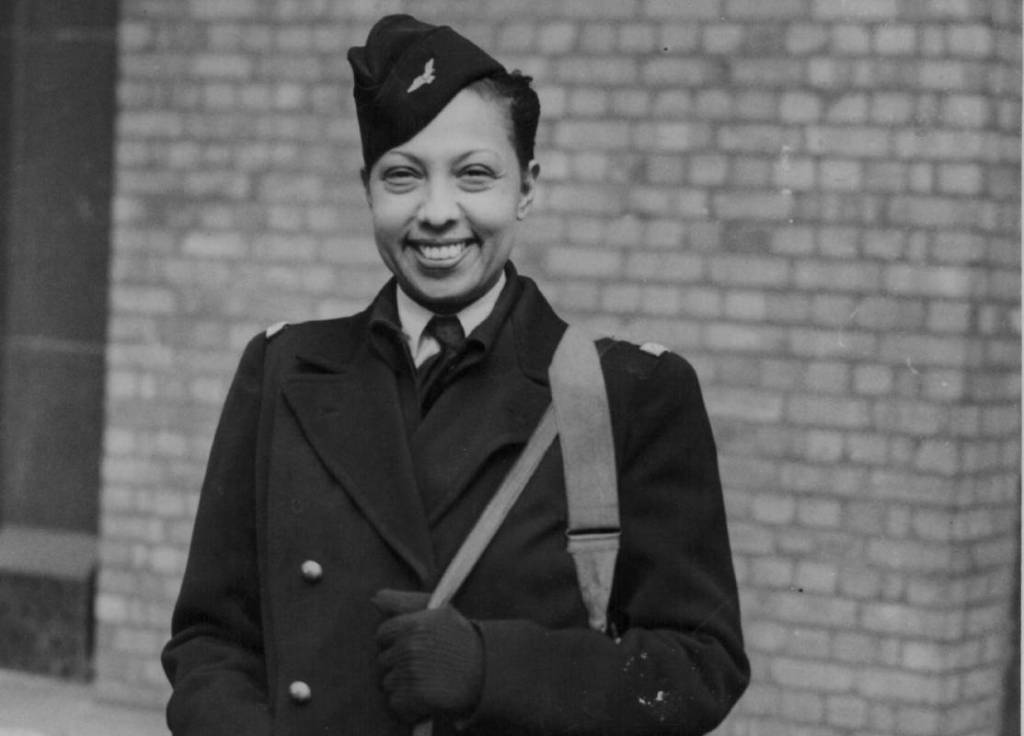
 Images courtesy of France Channel, “ Secrets d’Histoire: Joséphine Baker”
French history is often told through a familiar pantheon of kings, generals, philosophers, and revolutionaries—figures whose names fill textbooks and monuments. Even when women appear in this narrative, they tend to be a handful of iconic personalities. The most famous example is Joan of Arc, whose story of mystical conviction and military leadership has become a national myth. Yet beyond these celebrated figures lies a rich and often overlooked landscape of women who shaped France’s political, intellectual, and social history. Some influenced revolutions, others transformed science or resisted occupation, and many challenged the limitations placed upon them by their era. Their stories reveal how profoundly women contributed to the development of French society—even when official histories minimized their role.
The Revolutionary Voice: Olympe de Gouges
During the upheaval of the French Revolution, political participation expanded dramatically—but not equally. Women marched, debated, and organized, yet they were largely excluded from formal political power. One of the most remarkable voices of this moment was Olympe de Gouges. In 1791 she wrote the Declaration of the Rights of Woman and of the Female Citizen, a bold response to the revolutionary declaration that had proclaimed universal rights while effectively excluding women. Her argument was radical for its time: if the revolution stood for liberty and equality, then those principles must apply to women as well as men. She demanded equal legal rights, access to political participation, and recognition of women’s autonomy within marriage. Such ideas were perceived as dangerously subversive. De Gouges was executed during the Reign of Terror in 1793. Yet her writings anticipate modern feminist thought by more than a century. Today, she is increasingly recognized as one of the earliest advocates for gender equality in European political history.
The Scientific Pioneer: Sophie Germain
While political rights were contested in public spaces, another form of exclusion operated within the intellectual world. Universities and scientific academies were almost entirely closed to women. Despite these barriers, Sophie Germain emerged as a pioneering mathematician in the early nineteenth century. Unable to attend classes at the prestigious École Polytechnique because she was a woman, she secretly obtained lecture notes and corresponded with leading mathematicians under a male pseudonym. Her work on number theory and elasticity eventually earned recognition from the scientific establishment. She solved complex problems related to vibrating surfaces and laid foundations that influenced later mathematical research.
Germain’s story illustrates a recurring pattern in the history of women’s achievements: intellectual brilliance forced to operate in the shadows. Her perseverance in the face of institutional exclusion represents a quiet but powerful form of resistance.
The Revolutionary of Thought: Louise Michel
Few figures embody political courage as dramatically as Louise Michel. A teacher and activist, she became one of the most prominent participants in the Paris Commune. During the brief but transformative experiment in radical democracy that the Commune represented, Michel organized medical aid, fought on barricades, and advocated for social justice. After the Commune’s violent suppression, she was arrested and deported to New Caledonia. Rather than retreat into silence, Michel continued her activism in exile and upon her return to France. She became a symbol of revolutionary defiance, advocating for workers’ rights, anarchism, and gender equality. Her legacy reveals how women were not merely observers of political upheaval but active participants in shaping revolutionary movements.
The Courage of the Resistance: Lucie Aubrac
The twentieth century produced another generation of female heroes during the dark years of Nazi occupation. Among them was Lucie Aubrac, a key member of the French Resistance. Aubrac played a central role in organizing underground networks that sabotaged German operations and assisted Allied forces. Her most famous act of bravery occurred in 1943, when she orchestrated the daring rescue of her husband and other resistance prisoners from a Gestapo convoy. Her story captures the extraordinary courage required to resist totalitarian rule. Resistance fighters faced constant danger—arrest, torture, and execution—yet many continued their activities with remarkable determination. Women like Aubrac served as couriers, strategists, and organizers within resistance networks, demonstrating that the fight against occupation depended on far more than battlefield combat.
Cultural Influence: Josephine Baker
Heroism does not always arise from politics or war. Sometimes it emerges through culture and diplomacy. Josephine Baker, originally an American performer, became one of France’s most beloved cultural icons. Known for her groundbreaking career in music and dance, she also used her fame to support the French Resistance during World War II. Baker transported secret messages hidden within sheet music and used her international travels to gather intelligence for Allied forces. After the war, she continued advocating for civil rights and racial equality. Her life illustrates how cultural influence can intersect with political courage. Through artistry and activism, she reshaped perceptions of race, identity, and citizenship in France.
Why These Stories Matter
The relative obscurity of many female historical figures reflects broader patterns in how history is recorded and remembered. Traditional narratives often prioritize political leaders, military commanders, and institutional power—positions historically dominated by men. Women’s contributions, by contrast, frequently occurred in spaces less visible to official documentation: intellectual salons, grassroots activism, clandestine networks, or cultural life. Yet these contributions were no less significant. They influenced revolutions, advanced scientific knowledge, resisted oppression, and transformed cultural identity. Recognizing these figures does more than correct historical oversight. It expands our understanding of how change actually occurs—through countless individuals whose courage and creativity reshape society in ways that official histories sometimes overlook.
Rewriting the Historical Narrative
French history is richer and more complex than the traditional canon suggests. Alongside its celebrated heroes stand many women whose achievements deserve greater recognition. From the political audacity of Olympe de Gouges to the mathematical brilliance of Sophie Germain, from the revolutionary commitment of Louise Michel to the wartime bravery of Lucie Aubrac and the cultural influence of Josephine Baker, these figures reveal the breadth of women’s impact on French society. Their stories remind us that heroism is not confined to the most famous names. Often, it is found in the persistence of those who challenged injustice, expanded knowledge, or defended freedom—even when the world was slow to acknowledge their contributions.