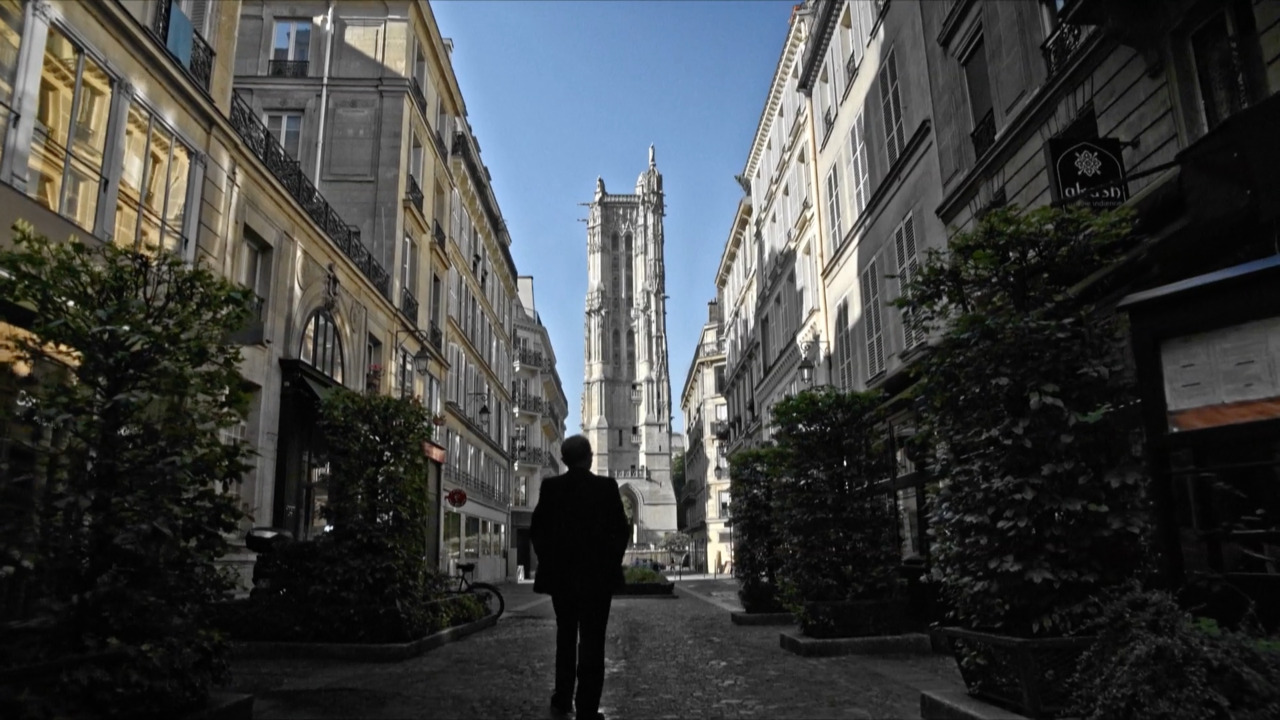
 Image courtesy of France Channel, “Paris Mysteries: The Alchemist” (2018)
The Man Behind One of Paris’s Greatest Mysteries
Few historical figures have become so thoroughly entangled with legend as Nicholas Flamel. Associated with the Philosopher’s Stone, the transmutation of metals and the secret of eternal life, Flamel has occupied a peculiar place in the popular imagination for centuries. His name evokes shadowy manuscripts, mysterious symbols and the promise of knowledge capable of overcoming the limits of nature. Yet the historical Nicholas Flamel was not a wizard or a mysterious hermit. He was a Parisian scribe and manuscript-seller who lived during the fourteenth and early fifteenth centuries. Born around 1330, probably in Pontoise, he established himself in Paris, where he worked as a professional copyist and bookseller. He became a prosperous citizen, acquired property and contributed generously to religious institutions.
The distinction between the historical man and the legendary alchemist is central to his story. There is no reliable evidence that Flamel practised alchemy or discovered the Philosopher’s Stone. In fact, much of the mythology surrounding him developed long after his death in 1418. But the gap between the modest historical record and the extraordinary legend is precisely what makes him so fascinating.
Medieval Paris: A City of Books, Knowledge and Secrets
To understand Flamel's later reputation, it helps to imagine the intellectual atmosphere of medieval Paris. During the fourteenth century, the city was an important centre of religious learning, manuscript production and scholarly exchange. Books were expensive objects, produced and copied by hand, and those who could write, reproduce and interpret texts occupied an important position in urban society. Flamel worked in this world as a scrivener and manuscript-seller. He was associated with the area around the church of Saint-Jacques-de-la-Boucherie, where he established his business. His profession placed him in contact with the written culture of his time, a world in which religious texts, philosophical works, scientific speculation and practical knowledge circulated alongside one another.
It is easy to see how a successful bookseller might later become associated with secret learning. In the popular imagination, the medieval manuscript was more than a book: it could be a repository of forbidden knowledge, an encoded message or a key to mysteries that ordinary readers could not understand. Flamel's historical occupation therefore provided an unusually convincing foundation for his transformation into an alchemical figure. He was a man whose life revolved around books, and the legend would eventually make him the possessor of the most extraordinary book imaginable.
The Philosopher’s Stone and the Search for Transformation
Alchemy is often misunderstood as simply an early, unsuccessful attempt to turn ordinary metals into gold. In reality, it was a complex intellectual and practical tradition that combined experimentation with philosophical, religious and symbolic ideas. Its practitioners investigated the properties and transformation of matter, seeking to understand the processes through which substances could be purified, altered and perfected. The ultimate symbol of this ambition was the Philosopher’s Stone, a legendary substance believed to enable the transmutation of base metals into precious ones.
In many alchemical traditions, the Stone was also associated with the Elixir of Life, a substance believed to restore health and prolong human existence. The search for material transformation consequently became intertwined with a much broader philosophical ambition: the possibility of overcoming imperfection, decay and mortality. This dual meaning helps explain the enduring appeal of alchemy. It promised not merely wealth, but a form of knowledge that could fundamentally alter the human relationship with the natural world. For Flamel, these ideas would eventually become the foundation of an extraordinary posthumous reputation.
The Mysterious Book of Abraham the Jew
The most famous story associated with Flamel concerns a mysterious manuscript known as the Book of Abraham the Jew. According to an account attributed to Flamel, he acquired an unusual book containing obscure illustrations and alchemical symbols. Its pages supposedly described the secret of metallic transmutation, but the knowledge was concealed behind an elaborate system of images and allegories. Unable to decipher the manuscript, Flamel allegedly spent years attempting to understand its contents. In the legend, he eventually travelled in search of someone capable of interpreting the text, encountering a learned man who helped him unlock its secrets.
The story culminates in the claim that Flamel successfully achieved the transmutation of metals, producing gold through the application of alchemical knowledge. It is a wonderfully elaborate narrative: the mysterious book, the hidden language, the journey in search of a teacher and the eventual discovery of an almost supernatural secret. It also contains many of the elements that would become familiar in later tales of occult knowledge. However, the historical reliability of this account is extremely doubtful. The texts that establish Flamel's reputation as an alchemist appeared long after his death, and there is no convincing evidence that he ever possessed such a manuscript. Rather than documenting a genuine discovery, the story appears to belong to the mythology constructed around his name.
Pernelle Flamel: The Woman Behind the Legend
No account of Nicholas Flamel is complete without mentioning his wife, Pernelle (also written Perenelle). She appears in the historical record as an important part of his life and later became an essential figure in the alchemical legend. The couple married in 1368. Pernelle had previously been married twice, and her existing wealth contributed to the couple's financial position. Together, they acquired property and became known for their charitable contributions, including donations to religious institutions.
In the popular mythology, however, Pernelle became much more than the wife of a prosperous Parisian bookseller. She was transformed into Flamel's companion in the pursuit of alchemical knowledge and, according to the legend, shared in the discovery of the Philosopher's Stone and the secret of longevity. The couple's supposed immortality became one of the most persistent elements of the Flamel story. Rather than simply having discovered a means of producing gold, they were said to have found a way to escape death itself. There is something particularly revealing about the way this legend developed. The historical couple's wealth and charitable activity were reinterpreted as evidence of extraordinary powers, while their long marriage became part of a story about the possibility of transcending ordinary human existence.
From Historical Figure to Immortal Alchemist
Perhaps the most surprising aspect of the Flamel legend is how late it emerged. Although Flamel died in 1418, his association with alchemy became prominent only centuries later. Alchemical texts began circulating under his name during the sixteenth and seventeenth centuries, including works that presented him as an authority on the Philosopher's Stone. One particularly influential text was the Livre des figures hiéroglyphiques, published in 1612. It purported to explain the mysterious figures that Flamel had supposedly commissioned for a Parisian cemetery, presenting them as visual expressions of alchemical wisdom.
The problem is that there is no convincing evidence that Flamel wrote the text. Its appearance nearly two hundred years after his death makes its attribution highly questionable. This process of attaching later writings to a famous historical figure is known as pseudepigraphy. It was not unusual in the history of alchemy, where the authority of an ancient or supposedly enlightened master could lend credibility to a text. Flamel's reputation was particularly useful in this respect. His documented prosperity, his association with books and his charitable foundations made him an appealing candidate for the role of the successful alchemist. Over time, the distinction between the real man and the legendary author became increasingly blurred.
The Symbols of Paris: A City Written in Stone
One of the most intriguing elements of the Flamel story is its connection to the physical landscape of Paris. The historical Flamel commissioned religious sculptures and inscriptions, including work associated with the church of Saint-Jacques-de-la-Boucherie. His tombstone, which he had designed during his lifetime, survived and is now preserved at the Musée de Cluny. These objects provide a tangible connection to a man who might otherwise seem almost entirely fictional. They also help explain why Flamel's legend has remained so closely associated with Paris.
The city itself has become part of the mythology. Its medieval streets, churches, old houses and surviving fragments of architectural decoration provide the perfect setting for stories about hidden knowledge and forgotten secrets. In particular, the association between Flamel and the former cemetery of the Innocents helped reinforce the idea that his religious and architectural commissions concealed an additional, esoteric meaning. The supposed alchemical interpretation of these images became central to later accounts of his life. The fascination lies in the possibility of reading the city as a text: looking at its buildings and monuments not simply as historical objects, but as fragments of a larger symbolic language.
Alchemy, Immortality and the Modern Imagination
Nicholas Flamel's reputation has continued to evolve well beyond the world of historical scholarship. His name has become familiar to readers and audiences who might otherwise know very little about medieval alchemy. One particularly influential modern appearance is in J.K. Rowling's Harry Potter and the Philosopher's Stone, where Flamel is presented as the alchemist who successfully created the Philosopher's Stone. In the fictional universe, he and his wife have lived for centuries thanks to the substance's extraordinary properties.
The choice is an inspired one. Flamel already occupied a space between documented history and supernatural legend, making him an ideal figure for a story about magic concealed within the ordinary world. His continued popularity also reflects a broader cultural fascination with alchemy. From Renaissance philosophy to modern fantasy, the image of the alchemist has remained associated with secret knowledge, forbidden experimentation and the possibility of transforming reality.
The Philosopher's Stone, in particular, has proved remarkably adaptable as a symbol. It can represent material wealth, spiritual enlightenment, scientific ambition or the human desire to escape mortality. Flamel's story brings all these ideas together.
The Enduring Mystery of Nicholas Flamel
The real Nicholas Flamel was a medieval Parisian whose life can be reconstructed through documents, property records, religious commissions and the surviving traces of his professional activity. He was a successful scribe and bookseller, a husband and a benefactor. There is no reliable evidence that he discovered the Philosopher's Stone or achieved immortality. And yet, centuries after his death, he remains one of the most recognisable names in the history of alchemy.
Perhaps the enduring appeal of Flamel lies precisely in the contrast between the ordinary and the extraordinary. A man whose profession involved copying and selling books became the supposed possessor of a manuscript containing the greatest secret in human history. A prosperous citizen became an immortal adept. A real Parisian couple became figures in a story about overcoming the limits of life itself. His legend reminds us that history is not made only of what can be proven. It is also shaped by the stories people tell about the past, the meanings they attach to surviving objects and the mysteries they choose to preserve. In that sense, Nicholas Flamel's greatest transformation may not have been the transmutation of metals into gold, but his transformation from a historical individual into an enduring figure of myth.