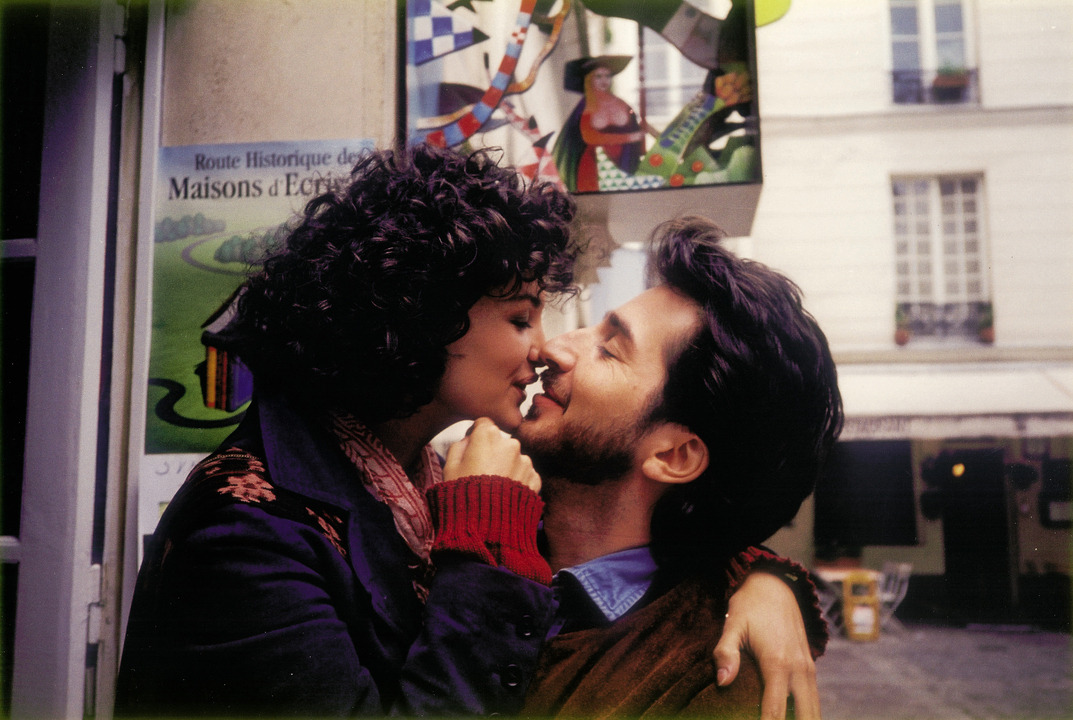
 Image courtesy of France Channel, “Dieu est grande, je suis toute petite” (2001)
In English, a kiss is simply a kiss.
In French, it depends.
Is it romantic? Friendly? Polite? Playful? Lingering? A greeting? A goodbye? A promise?
The French language does not treat a kiss as a single gesture. It categorizes it, softens it, intensifies it, or transforms it entirely — depending on context. And in doing so, it reveals something essential about French culture: affection is precise.
Here are the many ways to say “kiss” in French — and what each one truly means.
1. Un bisou — The Everyday Kiss
If you learn one word for “kiss” in French, it will likely be bisou.
A bisou is light, affectionate, and versatile. It can mean:
- A peck on the cheek
- A friendly goodbye
- A kiss blown in a text message
- A sign-off at the end of a casual email
- Friends say it. Parents say it. Lovers say it — but gently.
Text example:
À demain, bisous !
(See you tomorrow, kisses!)
It carries warmth without intensity. A bisou is sweet, but not dramatic.
2. Un baiser — The Romantic (and Risky) Kiss
At first glance, baiser appears to be the direct translation of “to kiss.”
Historically, it was.
But modern French complicates things.
As a noun, un baiser still means “a kiss,” often in a literary or romantic sense. It feels poetic, slightly formal, perhaps even old-fashioned.
Example:
Elle lui donna un baiser sur la joue.
(She gave him a kiss on the cheek.)
However, as a verb — baiser — it has evolved in colloquial French to mean something far more explicit. Using it casually can create awkward misunderstandings.
This dual meaning reflects how language shifts — and why precision matters in French romance.
3. Embrasser — To Kiss (Safely)
To avoid confusion, modern French typically uses embrasser to mean “to kiss.”
Example:
Ils s’embrassent sous la pluie.
(They kiss in the rain.)
Literally, embrasser means “to embrace.” And that overlap is revealing. In French culture, a kiss often implies closeness — not just lips touching, but bodies leaning toward one another.
It feels cinematic. Intimate. Clear in intention.
4. La bise — The Social Kiss
Perhaps the most culturally specific form of kissing in France is la bise.
This is not romantic. It is ritual.
The light cheek-to-cheek greeting exchanged between friends, colleagues, and acquaintances varies by region — sometimes one kiss, sometimes two, occasionally more.
“La bise” is not about passion. It is about connection and acknowledgment.
To “faire la bise” is to participate in social belonging.
For visitors to France, mastering la bise can feel more complex than conjugating verbs.
5. Un smack — The Playful Pecks
Borrowed from English, un smack refers to a quick, exaggerated peck.
It is often playful, theatrical, or humorous.
Parents might give children a smack. Friends might say it jokingly.
It is less poetic than un baiser, less soft than un bisou. It’s energetic, almost cartoonish.
6. Un bécot — The Affectionate Kiss
Less common but charming, un bécot suggests a small, affectionate kiss.
It feels slightly vintage — something heard in old films or playful banter.
Its tone is tender, perhaps nostalgic.
7. French Kissing (Le Baiser Profond)
Interestingly, what English calls a “French kiss” is not referred to that way in France.
Instead, you might hear:
- Un baiser profond (a deep kiss)
- Un baiser avec la langue (a kiss with the tongue)
The stereotype of France as the global authority on passionate kissing says more about international imagination than French vocabulary.
In France, even intense kisses are described with understated clarity.
Why French Has So Many Words for “Kiss”
The variety of terms reflects cultural nuance.
French society distinguishes between:
- Romantic love
- Familial affection
- Social ritual
- Playful tenderness
- Literary passion
A single English word cannot cover all these shades comfortably. French prefers precision — emotional specificity over generalization.
This linguistic sensitivity mirrors broader French romantic culture. Affection is not exaggerated. It is calibrated.
The Kiss as Cultural Language
In Paris, you might witness all these forms in a single afternoon:
Two friends exchanging la bise outside a metro station.
A couple s’embrassant on a quiet bridge.
A parent blowing a bisou toward a child from a bakery doorway.
Each gesture means something slightly different.
And each word captures that difference.
Because in French, a kiss is never just a kiss.
It is context.
It is relationship.
It is intention.
And perhaps that is the most romantic thing of all.