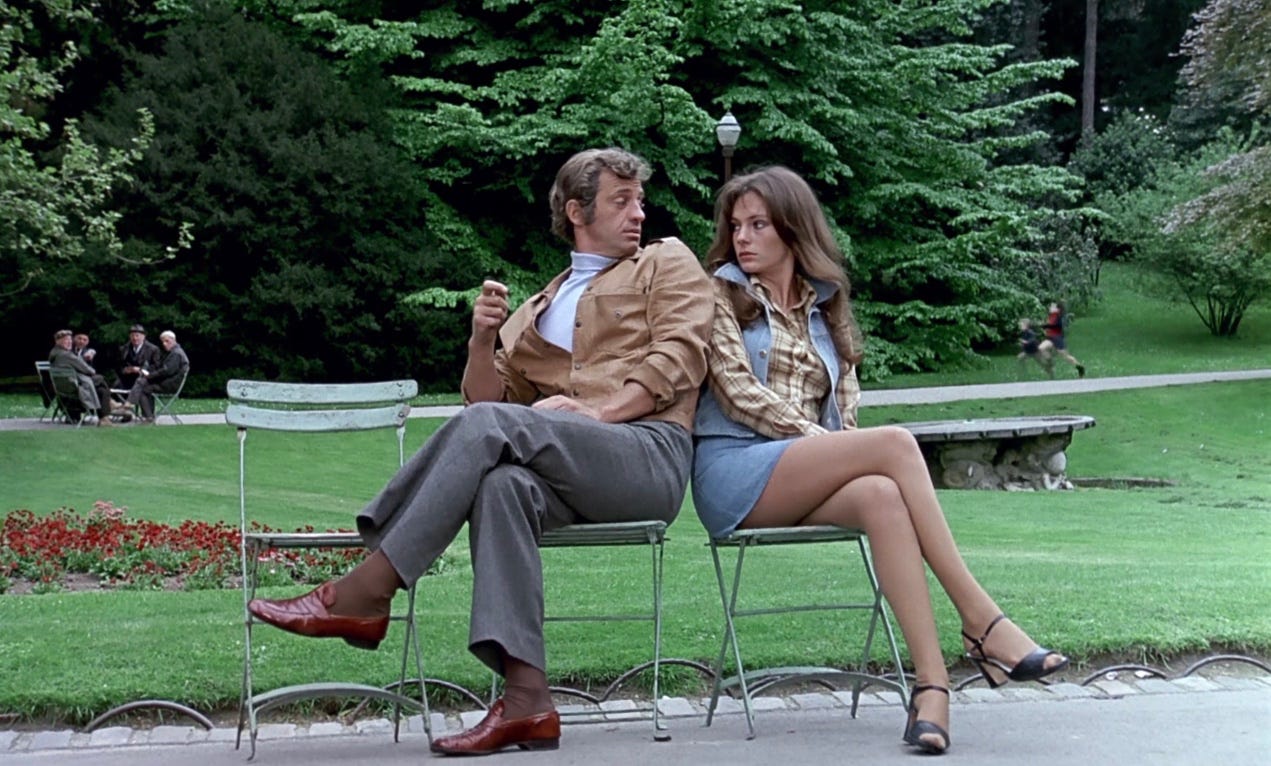
 Image courtesy of France Channel, “Le Magnifique,” (1973)
Paris in the spring is less a season and more a mood—soft light on limestone façades, café terraces filling back up, and an unmistakable sense that style matters again after winter’s heavy layers. Dressing for Paris in spring requires a balance: practical enough for shifting weather, yet effortlessly refined. To understand how to achieve that look today, it helps to look back at how fashion in Paris has evolved over the decades.
Dressing for Paris in Spring: The Essentials
Spring weather in Paris can be unpredictable. Mornings are crisp, afternoons can feel almost warm, and rain is always a possibility. The key is layering with intention. A classic trench coat is the backbone of a Parisian spring wardrobe. Lightweight but structured, it offers protection from sudden showers while maintaining a polished silhouette. Underneath, breathable layers—think cotton shirts, fine knits, or a simple blouse—allow flexibility throughout the day. Denim is a staple, but Parisians tend to favor clean cuts over distressed styles. Straight-leg jeans or tailored trousers pair easily with loafers, ballet flats, or low-profile sneakers. Footwear is practical yet understated; comfort matters because Paris is a walking city, but style is never sacrificed. Color palettes tend to stay neutral—beige, navy, black, white—with occasional soft pastels in spring. Accessories are minimal but intentional: a silk scarf, a leather handbag, a pair of understated sunglasses. The overall effect is curated without appearing overdone.
The Parisian Philosophy: Effortless, Not Careless
What sets Parisian spring style apart is the idea of nonchalance. Outfits are rarely loud or trend-driven. Instead, they reflect confidence in timeless pieces worn repeatedly and styled slightly differently each time. This philosophy didn’t emerge overnight—it’s the result of decades of evolving fashion culture.
1920s–1940s: Liberation and Elegance
In the 1920s, Paris was at the center of a fashion revolution. Women began to reject restrictive clothing in favor of looser silhouettes. This era introduced a sense of freedom—shorter hemlines, lighter fabrics—that still influences spring fashion today. By the 1940s, wartime austerity brought practicality to the forefront. Clothing became more functional, with simpler cuts and less excess fabric. This necessity laid the groundwork for the minimalist tendencies still seen in modern Parisian wardrobes.
1950s–1960s: Structure Meets Youth Culture
The post-war 1950s reintroduced glamour and structure. Cinched waists, full skirts, and tailored coats emphasized elegance. Spring fashion during this time was polished and intentional, often coordinated down to gloves and handbags. The 1960s, however, shifted dramatically. Youth culture began to dominate, and Paris embraced more playful, experimental styles. Short skirts, bold shapes, and lighter materials made fashion more accessible and expressive—an early sign of the relaxed spring dressing we see today.
1970s–1980s: Individualism and Power
The 1970s brought a more relaxed, bohemian influence—flowing fabrics, earthy tones, and a sense of individuality. This decade’s emphasis on personal expression resonates strongly with modern Parisian style, where individuality is subtly expressed within a classic framework. In the 1980s, fashion turned bold and structured again. Power dressing emerged, with strong shoulders and sharp tailoring. While today’s Parisian spring style is softer, the emphasis on well-cut pieces and quality tailoring remains a direct inheritance from this era.
1990s–2000s: Minimalism and Global Influence
The 1990s introduced a pared-down aesthetic: clean lines, neutral colors, and understated silhouettes. This decade arguably defines the modern Parisian look more than any other. The idea that less is more became central. By the 2000s, globalization and fast fashion began influencing trends more rapidly. Yet Paris maintained a resistance to overconsumption, favoring investment pieces over fleeting trends—a mindset that continues today.
Today: A Blend of Past and Present
Modern Parisian spring fashion is a quiet synthesis of all these decades. The trench coat nods to mid-century elegance, minimalist palettes reflect the 1990s, and relaxed layering echoes the 1970s. What has changed most is not the clothing itself, but the attitude toward it. Today, sustainability and longevity are increasingly important. Many Parisians prioritize fewer, better-made garments. Vintage shopping and mixing old with new have become part of the style language, reinforcing the idea that fashion is cyclical rather than linear.
Conclusion: Dressing with Awareness
To dress for Paris in the spring is to participate in a long-standing conversation between past and present. It’s about choosing pieces that adapt to the weather while reflecting a deeper understanding of style—one shaped by decades of cultural shifts. The result is not a rigid formula, but a mindset: invest in timeless items, layer thoughtfully, and wear everything with quiet confidence. In Paris, style isn’t about standing out—it’s about belonging to a tradition that continues to evolve, season after season.