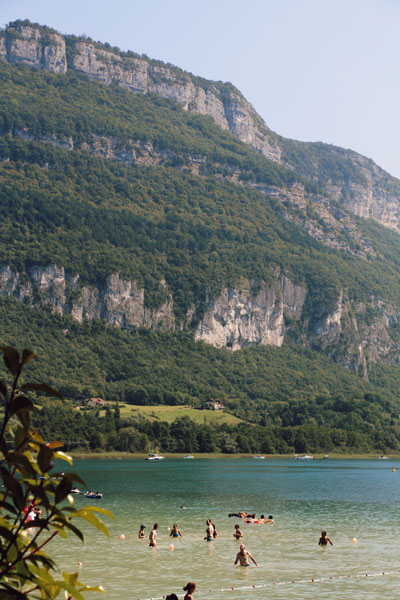
 Image courtesy of Fiona McMurrey, “Aix-Les-Bains,” near Annecy, 2021
Every summer, millions of people arrive in France with remarkably similar plans. They spend a few days in Paris, head south toward Provence, squeeze in a visit to the Côte d'Azur, and return home with beautiful photographs and a sense of accomplishment. There's nothing wrong with this itinerary. The famous destinations are famous for a reason.
But after enough time in France, you begin to notice something. The places people talk about most enthusiastically after their trip are rarely the ones they planned around. They're the places they discovered along the way. The city they stopped in for one night and stayed for three. The town that wasn't on the itinerary. The café terrace where they spent an entire afternoon doing absolutely nothing.
That's the version of France worth chasing in 2026. One of the country's greatest strengths is that some of its most rewarding cities continue to exist slightly outside the international spotlight. They're not hidden. They're simply overshadowed by bigger names. And because of that, they often feel more authentic, more relaxed, and more connected to everyday French life.
Take Lille, in the north. Most international visitors pass through the region on their way to somewhere else, which is unfortunate because Lille has many of the qualities people claim to be searching for when they visit France. The city is beautiful without feeling curated. Its streets are lively without becoming overwhelming. There is a distinct blend of French and Flemish influence in the architecture, the food, and even the atmosphere. Summer days unfold naturally there. You can spend hours wandering through markets, bookstores, and cafés without ever feeling pressured to move on to the next attraction.
Further west, Nantes feels like a city that has quietly reinvented itself while nobody was paying attention. It possesses the cultural energy people often associate with larger cities but without the crowds. Former industrial spaces have become creative hubs. Public art appears in unexpected places. The city seems comfortable experimenting with itself. What makes Nantes especially appealing is that it still feels like a place primarily designed for residents rather than visitors. When you spend time there, you feel less like a tourist and more like a temporary participant in local life.
In the south, many travelers rush directly to the Mediterranean coast and miss Montpellier entirely. That's a shame. Montpellier captures much of what people love about southern France without requiring a beachfront address. Students fill the city squares, outdoor cafés spill onto wide boulevards, and daily life seems to migrate outdoors as temperatures rise. Summer evenings stretch effortlessly into the night. A quick drink becomes dinner. Dinner becomes a walk through the historic center. The walk somehow lasts until midnight. Nobody appears particularly surprised by this.
Toulouse offers a similar lesson. Often overlooked in favor of Bordeaux or the Mediterranean coast, the so-called Pink City possesses a warmth that extends beyond its distinctive brick buildings. There is something inherently easy about life in Toulouse. People gather along the riverbanks after work. Conversations seem to last longer. Meals unfold more slowly. During summer, the city develops a rhythm that encourages visitors to stop measuring their days by what they accomplished and start measuring them by how much they enjoyed them.
Perhaps that's why so many of France's less obvious cities feel memorable. They aren't competing for your attention every minute. They don't demand that you check landmarks off a list. Instead, they invite you to settle into a pace of life that can feel increasingly rare.
Dijon is a perfect example. Most people know the name but very few make it a priority destination. Yet the city offers beautiful architecture, exceptional food, and immediate access to some of the world's most celebrated wine country. What it lacks in international hype, it makes up for in quality of life. Days there seem designed around pleasure rather than productivity. Morning markets blend into long lunches. Afternoon walks become wine tastings. Entire evenings disappear into conversation.
Even Annecy, which has become increasingly popular in recent years, still manages to feel refreshingly different from France's most crowded summer destinations. The lake, the mountains, and the historic center create a setting so picturesque that it almost feels fictional. Yet what stays with visitors isn't usually the scenery. It's the lifestyle. People swim before work. Families spend evenings by the water. Cyclists, runners, and walkers seem to have collectively decided that spending time outdoors is the most sensible use of a summer day.
The common thread running through all of these places is that they encourage a different kind of travel. They reward curiosity rather than efficiency. They remind visitors that a successful trip isn't necessarily the one where you see the most things. It's often the one where you experience a place deeply enough to adopt some of its habits.
France, at its best, teaches people how to enjoy time rather than simply manage it. That's particularly true in summer. Long lunches are not interruptions. Evening walks are not filler between activities. Sitting at a café for two hours with no agenda is not wasted time. These moments are the experience.
So if you're planning a trip to France in 2026, consider leaving some room in your itinerary for the places that receive fewer headlines. Skip at least one destination you're supposed to visit. Choose a city you know very little about. Give yourself permission to wander, linger, and occasionally take the wrong turn. The landmarks will always be there. The famous viewpoints aren't going anywhere. What you'll remember, years later, are the moments in between: the market you stumbled upon, the terrace where you stayed longer than intended, the evening that unfolded without a plan, and the city you almost didn't visit at all. Those are often the places that end up feeling the most like France.